
Based on Outlive: The Science & Art of Longevity and Global Healthspan-Lifespan Gaps Among 183 World Health Organization Member States
Most of us will spend our final decade in decline. It doesn’t have to be that way.
Here’s a truth most of us don’t want to sit with: modern medicine has gotten very good at keeping us alive, and not nearly as good at keeping us healthy.
The average person today can expect to live into their late seventies or eighties but the last ten to twenty of those years are often spent managing chronic disease, losing mobility, and fading cognitively.
That’s the gap between lifespan (how long you live) and healthspan (how long you live well). The good news? That gap is largely within your control.
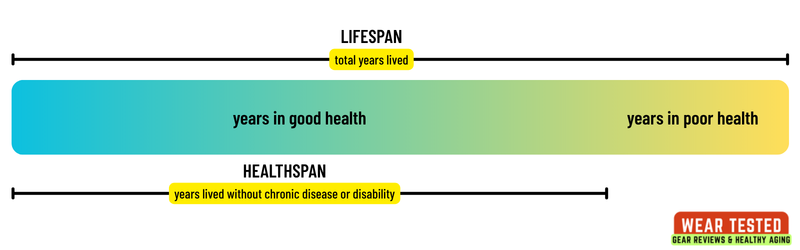
What is the healthspan lifespan gap, representing the number of years burdened by disease, in men and women across the world?
Based on the latest cross-sectional study, Global Healthspan-Lifespan Gaps Among 183 World Health Organization Member States, it quantified healthspan-lifespan gaps among 183 World Health Organization member states. Globally, the mean healthspan-lifespan gap was 9.6 years, and women exhibited a mean 2.4-year larger gap than men, associated with a disproportionately larger burden of noncommunicable diseases in women.
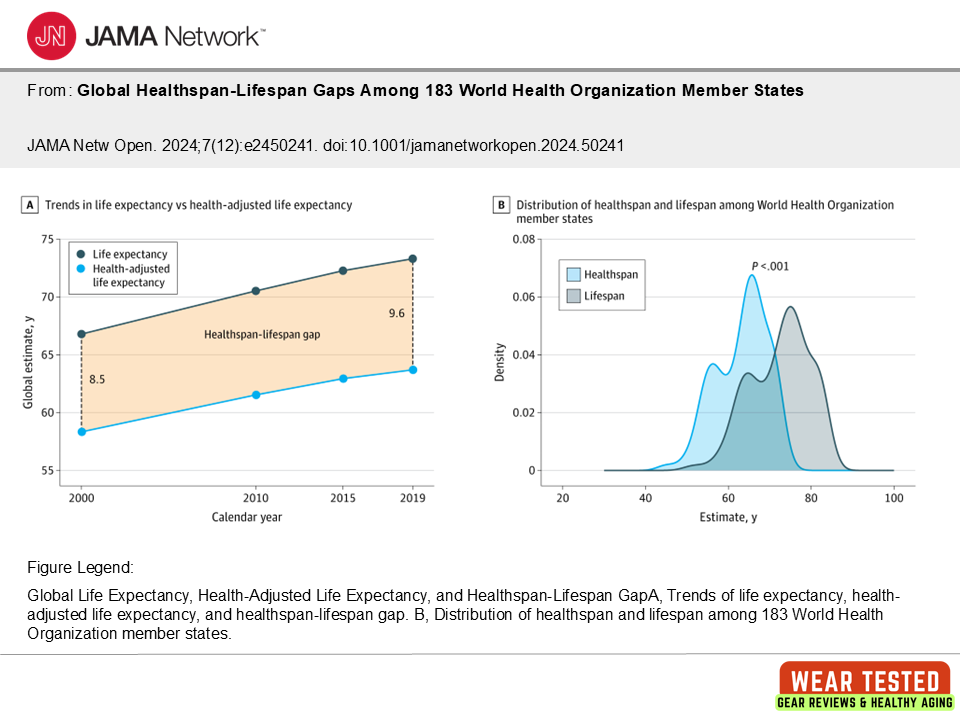
These findings suggest that the healthspan-lifespan gap is a universal threat to healthy longevity.
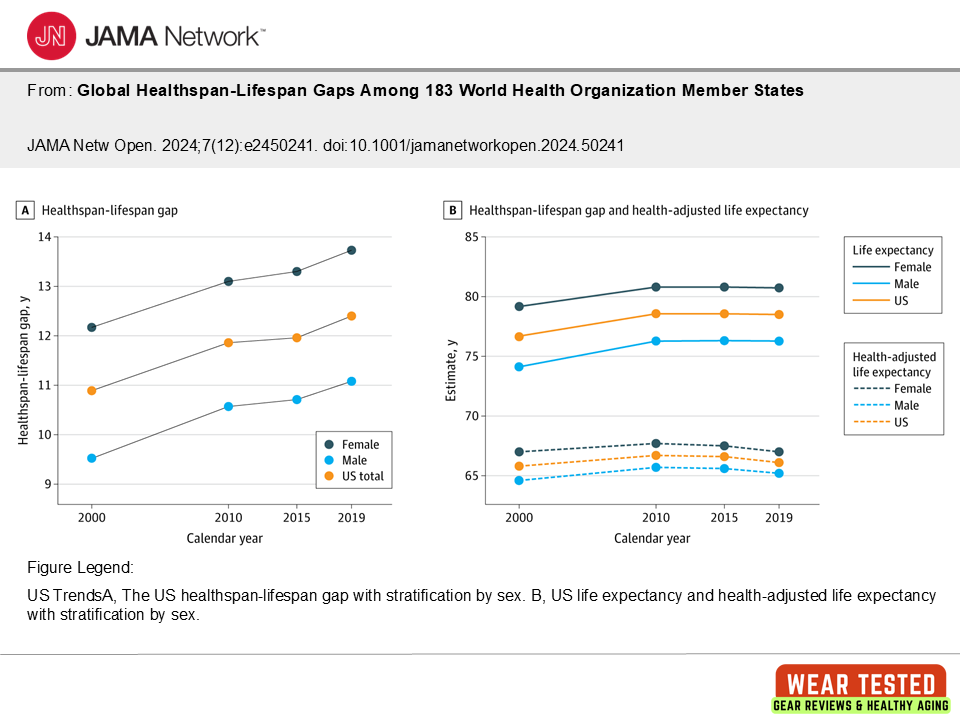
The USA presented the largest healthspan-lifespan gap, amounting to 12.4 years, underpinned by a rise in noncommunicable diseases. The mean healthspan-lifespan gap increased from 10.9 to 12.4 years over the past 2 decades, resulting in a 29% higher gap than the global mean. Women exhibited a 2.6-year higher healthspan-lifespan gap than men, increasing from 12.2 to 13.7 years or 32% beyond the global mean for women.
Controlling The Gap (Peter Attia Framework): Start at the End
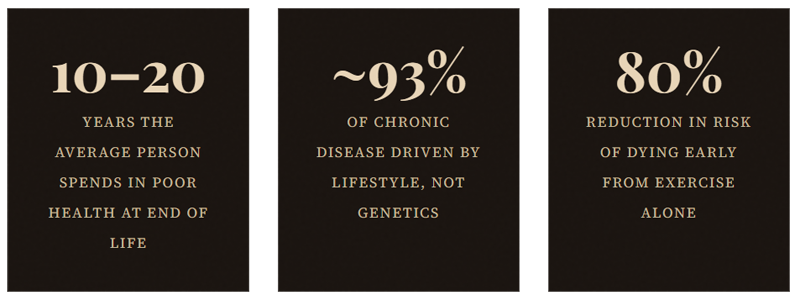
Dr. Peter Attia, a physician and longevity expert who wrote Outlive: The Science and Art of Longevity, flips the conventional health conversation on its head. Instead of asking “how do I avoid dying soon?” he asks his patients a more vivid question:
“What do you want to be able to do at 80 or 90 – and are you building the body and mind today that can actually get you there?”
– Dr. Peter Attia, Outlive
He calls this your “Centenarian Decathlon” – a personal list of 10 physical and cognitive tasks you want to still be capable of in your final decades. Not Olympic feats. Real things. Playing with grandchildren on the floor. Carrying your own groceries. Taking a hike. Climbing stairs without fear. Being sharp enough to hold a conversation, remember a name, learn something new.
We’ve touched on this almost two years ago (The Ultimate Fitness Blueprint for Living Strong and Healthy at 100) but the topic keeps coming back.
Once you know what you’re building toward, you can work backward, decade by decade, to figure out what you need to be doing right now. This is fundamentally different from how most people think about health, which is reactive: we only change when something goes wrong.

- Live Longer, Stress Less
- Lifespan, Healthspan, Diseasespan
- Centenarian Decathlon
- Strength & Power Training
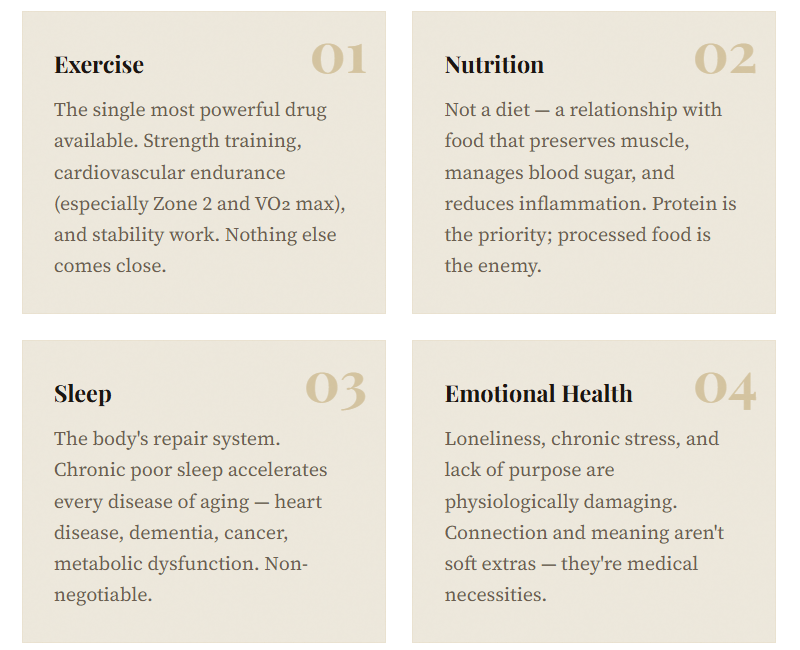
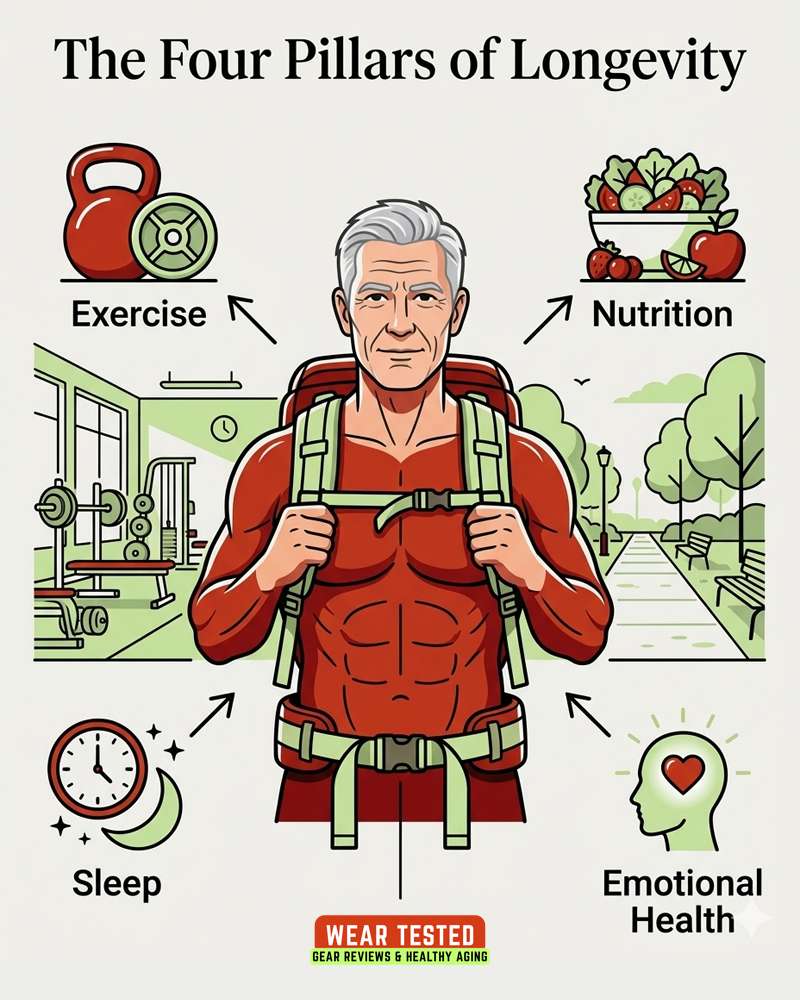
The Four Pillars Attia Says You Must Get Right
Attia distills the science of longevity into four primary levers. Pull them consistently and you dramatically narrow the gap between how long you live and how well you live.
Working Backwards: What to Do Each Decade
Attia’s insight is that the body you’ll have at 80 is being built – or destroyed – in your 30s, 40s, and 50s. Most age-related diseases take decades to develop. Most of the window to intervene closes quietly, while we’re not looking.
30s – Build the Foundation
This is the decade most people waste. Get serious about strength training – you’re building the muscle reserve that will protect you decades from now. Establish sleep hygiene. Get baseline blood work: ApoB, fasting insulin, blood pressure. Identify and address metabolic risk early.
40s – Defend and Expand Capacity
Muscle loss and VO₂ max decline begin in earnest. Prioritize high-intensity cardio to protect your aerobic ceiling. Increase protein intake. Screen more aggressively for cancer and cardiovascular disease. Begin seriously managing stress – it compounds with age. This decade sets your trajectory.
50s – Protect What You’ve Built
Hormonal shifts, bone density loss, and cognitive vulnerability all accelerate. Strength training becomes critical for bone and balance. Prioritizing social connection – isolation at this age is as damaging as smoking. Double down on sleep. Review and tighten all the pillars.
60s+ – Convert Investment into Freedom
If you’ve done the work, this is where it pays. Mobility, strength, and mental sharpness don’t have to decline dramatically. Stay active, stay connected, keep learning. The goal is function – the ability to do what you love, independently.
The Centenarian Decathlon: Write Your Vision Now
Attia asks his patients to be specific, disturbingly specific, about what they want their life to look like at the end. Not “I want to be healthy.” Something you can picture like:
- “I want to hike a mountain at 75”.
- ” I want to carry my grandkids”.
- “I want to drive myself to dinner at 85”.
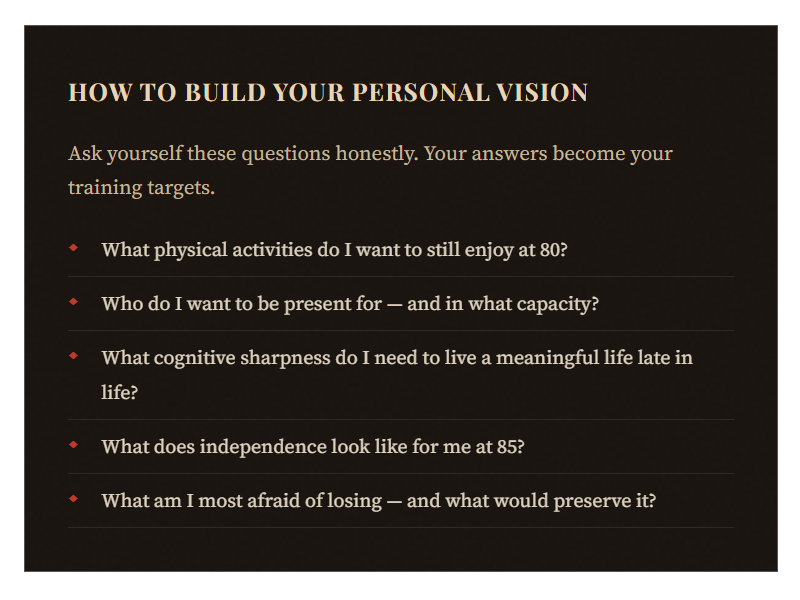
Once you have that picture, Attia says, you realize your current habits are either building toward it or eroding it. There’s no neutral. The person who sits all day, sleeps poorly, eats whatever, and never lifts anything heavier than a phone is training – training to be frail.
Exercise: The Non-Negotiable, Broken Down Simply
Attia is emphatic: exercise is the most powerful longevity intervention that exists. More than any drug, supplement, or medical procedure. Here’s what he actually recommends, in plain terms:
- Zone 2 cardio, 3–4 hours per week: A pace where you can hold a conversation but feel it. Walking briskly, cycling, swimming. This builds your engine – mitochondrial health and metabolic efficiency.
- Strength training, 2–3 times per week: Lifting things. Squats, deadlifts, presses, rows. This is the single best defense against frailty, falls, and metabolic disease.
- VO₂ max training, 1 session per week: Short, hard efforts that push your heart rate to its ceiling. This is your aerobic ceiling – and it’s one of the strongest predictors of how long and well you’ll live.
- Stability and mobility work: Don’t neglect balance and flexibility. A fall at 75 can be catastrophic. Yoga, Pilates, or targeted balance work matters more than people think.
Nutrition: Simpler Than the Internet Makes It
Attia doesn’t push a specific diet – keto, paleo, plant-based. He focuses on a few principles that the evidence actually supports:
- Eat enough protein. Most people dramatically undereat protein, especially as they age. Attia recommends roughly 1 gram per pound of body weight per day. Protein preserves and builds muscle – which preserves your life.
- Cut ultra-processed food. Not because of any single ingredient, but because of what it does to your overall eating patterns, blood sugar, and inflammation. Real food, most of the time.
- Control what you drink. Alcohol is not healthy food. It disrupts sleep, adds empty calories, and has no proven longevity benefit at any dose.
- Know your metabolic numbers. Blood glucose, insulin, ApoB (a key cholesterol marker). You can’t fix what you don’t measure.
Sleep: The Underrated Superpower
Attia calls sleep “the most underrated health intervention available.” During deep sleep, your brain physically clears out the toxic waste products – including the amyloid plaques associated with Alzheimer’s – that accumulate during the day. Miss sleep chronically and you’re allowing biological damage to compound, night after night.
His practical guidelines: aim for 7–9 hours. Keep your room cold and dark. Consistent sleep and wake times matter more than duration alone. Limit alcohol, which destroys sleep quality even when it helps you fall asleep. And take sleep disorders like apnea seriously – they silently accelerate every disease of aging.
See our article on Sleep – The Shorter Your Sleep, The Shorter Your Life Span
Emotional Health: The Pillar People Skip
This is where Attia diverges most sharply from conventional medicine. He devotes an entire section of Outlive to emotional health – not as a bonus feature of wellness, but as a biological necessity for longevity.
Social isolation is as damaging to your health as smoking 15 cigarettes a day. Chronic, unmanaged stress floods your system with cortisol, which degrades sleep, immune function, cardiovascular health, and cognitive performance. A lack of purpose or meaning – feeling like your days don’t matter – has measurable physiological effects.
- Invest in relationships actively. Not passively. Schedule time with people you love the way you schedule workouts.
- Address your stress at the root. Breathwork, therapy, meditation, journaling – find what works and be consistent.
- Find work or purpose that pulls you forward. People with a strong “why” live longer. It’s not philosophy. It’s physiology.
The Bottom Line
“The goal is not to live forever. The goal is to be fully alive for as long as you live.”
The gap between lifespan and healthspan is not inevitable. It is, in large part, a consequence of choices made slowly, invisibly, over decades. The hopeful flip side of that truth is this: the choices you make now – to move your body, nourish it well, sleep deeply, and tend to your relationships – are investments in a future self that is still capable, still sharp, still joyful.
Attia’s framework doesn’t promise immortality. It promises something better: a life where your final chapter is still a good chapter. Where 80 doesn’t mean managed decline – it means a person who still shows up fully for the people and experiences that matter most.
You don’t have to be perfect. You have to start. And keep going.
References
The Centenarian Decathlon is a conceptual framework introduced by Dr. Peter Attia (in his book Outlive: The Science and Art of Longevity) to help individuals prepare for a long and healthy life, aiming to maintain the ability to perform essential physical activities even at an advanced age. While it is not a literal decathlon with specific events (like the National Senior Games), Dr. Attia outlines a variety of exercises and physical competencies that are crucial for maintaining health and functionality into old age. These exercises focus on building and maintaining strength, balance, flexibility, and cardiovascular fitness.
Garmany A, Terzic A. Global Healthspan-Lifespan Gaps Among 183 World Health Organization Member States. JAMA Netw Open. Dec 2 2024;7(12):e2450241. https://doi:10.1001/jamanetworkopen.2024.50241