
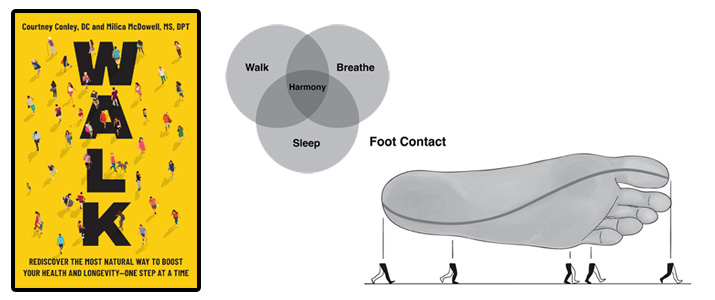

What James Nestor did for breathing, Christopher McDougall and Mark Cucuzzella did for running, and Kelly and Juliet Starrett have done for mobility, founder of Gait Happens Dr. Courtney Conley and Dr. Milica McDowell do for walking.
Two movement clinicians with over four decades of combined experience argue that walking (done right) is the most underutilized medicine on earth.
Walking is as important to our health and longevity as sleep and proper breathing; it is the 6th vital sign. And yet we’ve almost engineered it out of our lives. Walk is an expert-driven, science-backed guide that not only underscores the power of movement to just about every aspect of our life, but it also restores walking to its rightful spot as one of the key pillars of health.
If you asked most people over 50 what they’re doing for longevity, you’d hear a familiar list: strength training, Zone 2 cardio, sleep hygiene, supplements, maybe cold plunges. What almost nobody mentions is their feet. That’s the premise, and the provocation, at the center of Walk, the new book from chiropractor Dr. Courtney Conley and physical therapist Dr. Milica McDowell.
Walk makes a deceptively simple argument: walking is a physiological necessity – in the same category as breathing and sleeping – and the modern neglect of it, combined with decades of structurally compromising footwear, is quietly undermining the health and independence of millions.

The Core Argument: Mobility Is Longevity
Conley and McDowell open with a phrase that anchors the entire book: mobility equals longevity. Their argument isn’t metaphorical. A growing body of research connects daily step count to all-cause mortality, dementia risk, cardiovascular outcomes, and depression – and Walk engages with that literature directly, citing meta-analyses from the European Journal of Preventive Cardiology, JAMA Neurology, and GeroScience, among others.
But the authors go further than step counts. They argue that how you walk (your gait mechanics, foot strength, and footwear) matters as much as how much you walk. Toe weakness, they note, is a significant predictor of falls in older adults, and falls are among the leading causes of functional decline and mortality in people over 65. This frames foot health not as a cosmetic or comfort issue but as a genuine longevity variable.
“Walking is essential to our survival and continued existence as a species, yet globally, today’s humans simply aren’t walking enough.”
– Conley & McDowell, Walk (2026)
The book’s title for walking, “Vitamin W”, reflects this positioning. And in perhaps its boldest claim, Walk introduces walking as a sixth vital sign, one the authors argue the healthcare system should formally recognize alongside heart rate, blood pressure, respiration, temperature, and oxygen saturation. Given that foot pain alone restricts exercise, sleep, work, and the ability to play with grandchildren, the case isn’t difficult to make.
What the Book Actually Covers
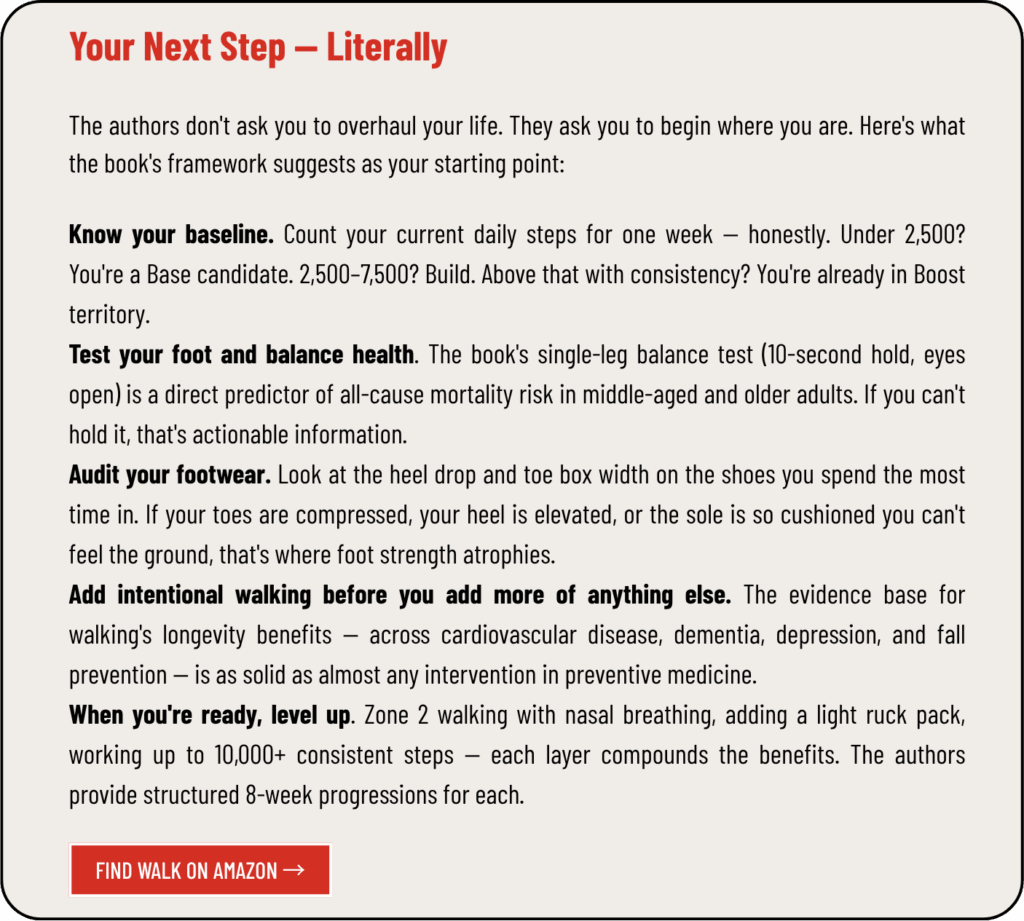
Walk is structured in two halves. The first establishes the why – the science of walking’s physical, mental, and emotional benefits, what happens to the body when we don’t walk enough, and the often-overlooked role of foot health in overall wellbeing. The second half is operational: how to assess your current baseline, choose smarter footwear, build functional foot strength, and implement a structured walking program suited to where you are right now.
PART 1
The Science of Walking
Why walking is a physiological necessity, its documented effects on lifespan and mental health, and the costs of modern sedentary patterns.
PART 2
Your Foot Health Baseline
Self-assessments for foot strength, mobility, and fall risk – including the one-leg balance test linked to longevity prediction.
PART 3
The Footwear Question
Why conventional shoes compromise gait mechanics, how to transition to functional or minimal footwear safely, and what to look for in a shoe.
PART 4
Walking Programs & Level-Ups
Three-tiered programs (Base, Build, Boost) plus advanced progressions: Zone 2 walking, strength work, rucking, and long-haul walking.
The footwear chapter is likely to resonate – or provoke – most for performance-minded readers. Conley and McDowell draw on biomechanics research to argue that stiff, narrow, elevated-heel shoes effectively switch off the intrinsic foot muscles over time, reducing proprioception, weakening the structures that absorb ground-reaction forces, and progressively shifting gait mechanics in ways that ripple up through knees, hips, and lower back. Minimal and wide-toe-box footwear, they argue, restore sensory feedback and rebuild the foot’s structural capacity – but only with a gradual transition.
Of course, we know all that already since 2010 when we started writing about it here and at the Natural Running Center. And there are only about 4 shoe companies left that are truly focused on a wide range of healthy minimalist shoes: Xero Shoes, LEMs Shoes, Altra Running, and VIVOBAREFOOT.

- Transitioning to Minimalist Shoes
- Strength Building With Rucking Article
- Improving Bone Density & Blood Pressure With Rucking Article
Beyond Steps: The Walking Upgrade Path
One of the more useful contributions of Walk is its nuanced progression model. Rather than simply advocating for “more steps,” the final chapters sketch an upgrade path from baseline ambulatory health toward genuinely advanced walking-based fitness. Zone 2 heart-rate walking, structured rucking (weighted walking, increasingly documented for bone density, cognitive function, and cardiovascular conditioning), and what the authors call “long-haul walking” are all covered with specific protocols and physiological rationale.
The movement snacks concept – brief, intentional movement breaks distributed through the day – threads through every chapter as a practical bridge between aspiration and reality for people with desk-heavy lifestyles. It’s a behavioral design insight borrowed from the habits literature and applied sensibly to movement ecology.
WHO SHOULD READ THIS
Readers who think they already exercise enough but haven’t thought about their feet. People managing early joint pain or fall anxiety. Anyone in their 40s, 50s, or 60s building a longevity protocol from first principles. Runners and cyclists whose lower-body training has never included dedicated foot work.
THE AUTHORS
Forty Years of Clinical Ground Truth
Dr. Conley is a chiropractor specializing in foot function and gait analysis, founder of Gait Happens. Dr. McDowell is a Doctor of Physical Therapy whose own decade-long recovery from a misdiagnosed foot fracture shaped her clinical philosophy. Their combined patient experience grounds the book’s science in real-world outcomes.