The information provided in this article is for educational and informational purposes only and is not intended as health or medical advice. Do not use this information to diagnose or treat any health condition. Always consult a qualified healthcare provider regarding any questions you may have about a medical condition or health objectives. Read our disclaimers.
Table of Contents
What Are Minimalist Shoes?
What Are The Benefits?
Level 0 Program – Foot Exercises
Level 1 Program – Transitioning from Traditional Shoes to Hybrid Minimalist Shoes
Level 2 Program – Transitioning from Hybrid Minimalist Shoes to True Minimalist Shoes
Recent Studies and Statistics
References
Best In Class Minimalist Shoes
Additional Resources
Transitioning to Minimalist Shoes Special Report
If you prefer to read this offline at your leisure or in reading/book mode, please sign upto download the eBook PDF (55+ pages).
What Are Minimalist Shoes?
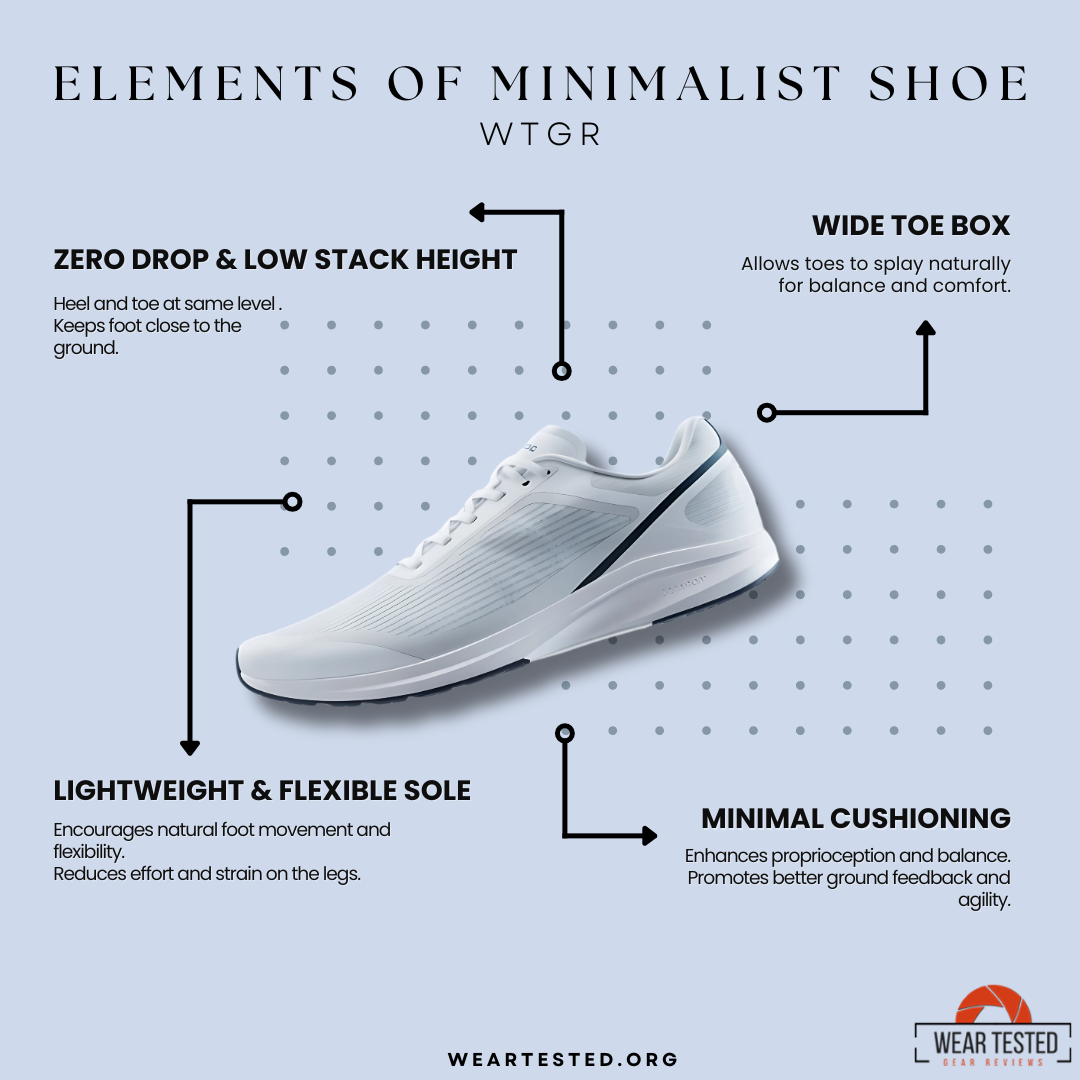
Minimalist shoes, often called barefoot shoes, mimic the natural shape and function of the foot. They typically feature:
Thin, flexible soles
Wide toe boxes
Little (less than 4mm) to zero heel-to-toe drop (or differential)
Minimal cushioning and support
No motion-control features
The goal is to allow your feet to move, flex, and sense the ground as they would if barefoot, promoting natural biomechanics.
Two main categories of minimalist shoes are:
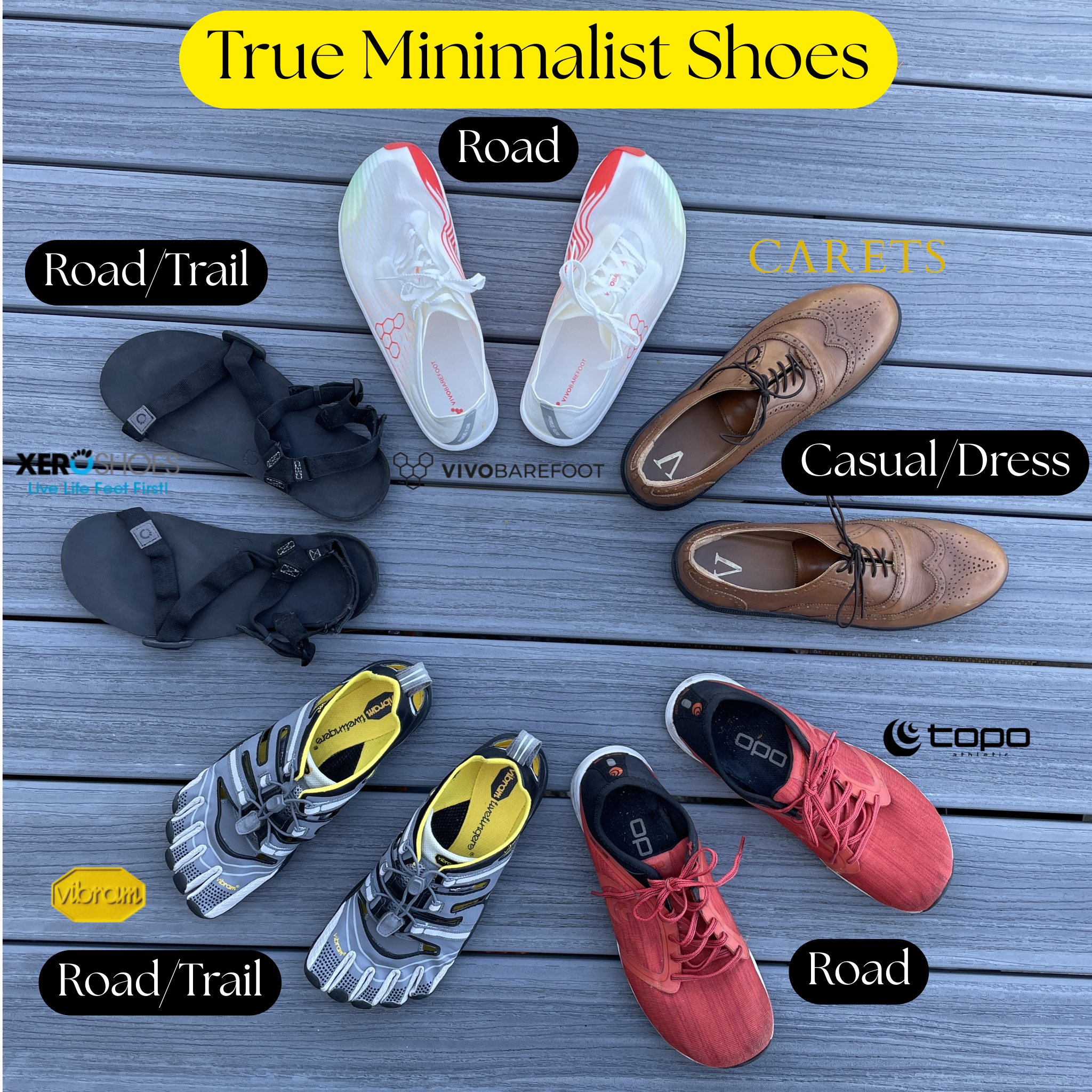
Barefoot-style shoes or True Minimalist Shoes (zero-drop, almost no cushioning, wide toe box)
Minimalist Hybrid or Transitioning Shoes (4mm, some cushioning, wide toe box)
Transitioning/Hybrid minimalist shoes and True minimalist shoes have these characteristics in common:
Low to Zero Drop
Unlike traditional running shoes that have a higher heel-to-toe differential, true minimalist shoes have a zero-drop design (0mm differential). This encourages a more natural midfoot or forefoot strike rather than a heavy heel strike. Some transitioning minimalist shoes have 3mm to 4mm differential.
If you’re used to running with a heel-striking pattern, minimalist shoes will help you gradually adjust to a more natural gait (midfoot to forefoot striking).
Low to No Cushioning
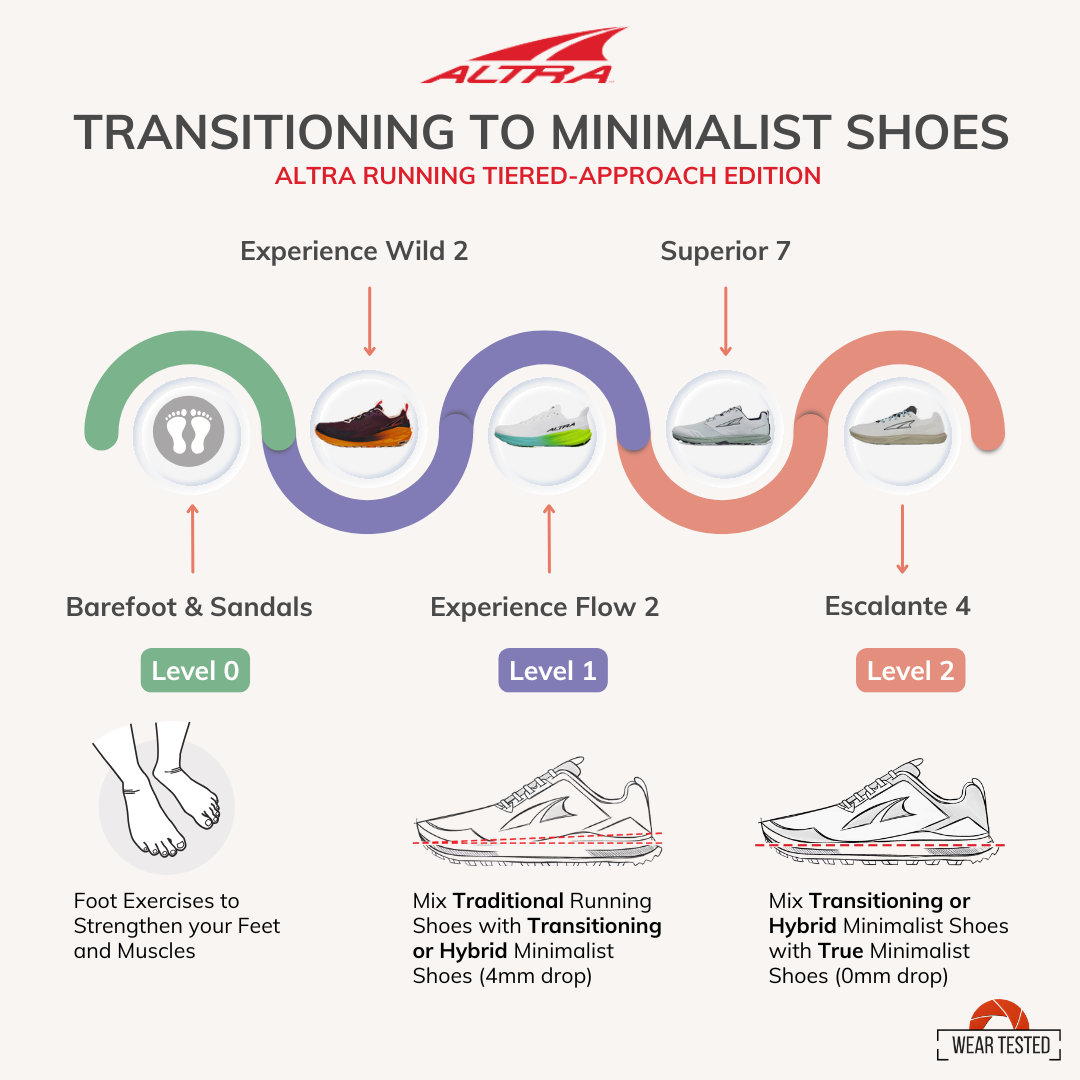
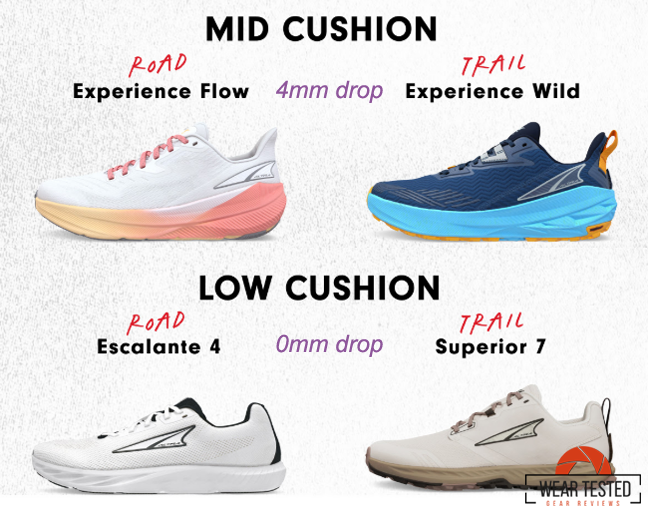
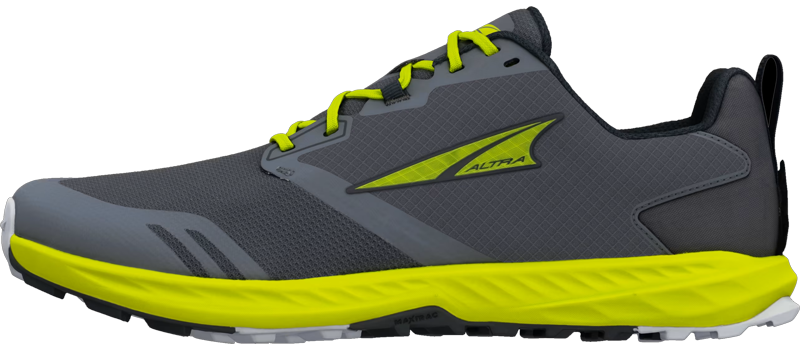
True minimalist shoes (like Altra Escalante 4 and Altra Superior 7) have little to no cushioning.
Transitioning minimalist shoes (like Altra Experience Flow 2 and Experience Wild 2) have moderate cushioning, which makes it more forgiving on your feet and legs during the transition phase.
Flexible & Lightweight
The midsole and outsole are soft and flexible, allowing your feet to move more naturally compared to stiff, structured running shoes. This helps strengthen foot muscles and tendons without the immediate shock of going fully minimalist.
Wide Toe Box for Natural Foot Splay
One of the biggest advantages of the wide toe boxes (like Altra FootShape™) is that it allows your toes to spread out naturally. This helps develop stronger foot muscles and improves balance, a crucial step in transitioning to minimalist running.
One straightforward way to tell a true minimalist shoe from a transitioning minimalist shoe is by the amount of cushioning they have and the heel-to-toe differential. Both types of minimalist shoes should have wide toe boxes, flexible soles, and are lightweight as discussed above.
What Are The Benefits of Minimalist Shoes?
Over the past 15 years, there have been numerous scientific studies on the benefits of minimalist shoes. Highlighted below are some of the findings.
Improved Foot Strength and Muscle Size
Multiple studies show that wearing minimalist shoes can significantly increase intrinsic foot muscle strength and size. A systematic review found strengthincreases between 9-57% and muscle size increases of 7-11% over several weeks.
An eight-week study reported an 8% increase in foot muscle mass among participants who walked in minimalist shoes.
Enhanced Balance, Proprioception, and Mobility
Minimalist shoes improveproprioception (the sense of foot position and movement) and balance, as they allow for more natural foot movement and sensory feedback.
Runners also experience better stability and a wider range of motion.
Natural Running and Walking Mechanics
Minimalist and barefoot shoes encourage a midfoot or forefoot strike, reducing ground contact time and potentially improving running efficiency.
Traditional shoes promote a heel strike, which is less common in barefoot populations and linked to higher injury rates.
Potential Reduction in Certain Injuries
Some evidence suggests minimalist shoes may reduce hip, knee, and back pain, and improve conditions like bunions and plantar fasciitis by allowing the foot to function naturally.
However, improper transition can increase injury risk, especially in the ankles and calves, due to new loading patterns.
Improved Posture and Body Awareness
Runners also experience improved posture and body alignment, as stronger feet provide a better foundation for movement.
Risks and Challenges of Transitioning
Injury Risk: Sudden transition can lead to overuse injuries, particularly in the calves and feet, due to increased demands on muscles and tendons. It happened to me in 2010 and took an additional 6 months to recover fully.
Initial Discomfort:Soreness or pain is common during the initial stages as the feet adapt to new movement patterns. Expect this to last months…
Our websites Wear Tested Gear Review and Natural Running Center focuses on minimalist shoes and natural running since our founding in 2010. Based on our experiences with transitioning from 12mm and 8mm heel-to-toe drop traditional running shoes and heel striking without guidelines, we’ve seen injuries from transitioning too fast without the right shoes. We’ve also discovered the miracle of natural running in minimalist shoes – injury-free, pain-free (lower back) sustainable running.
Based on our 15 years wearing and testing exclusively minimalist shoes from every category including road, trail, walking, dress, and casual, we now share all that wisdom on transitioning safely without injuries – it took me 9 months to transition correctly after 6 months of injuries when transitioning too fast back in 2010…
Step-by-Step Smooth Transition Guide
“Slow and Careful”
In A Nutshell
Start with Walking & Short Runs
Wear the transitioning minimalist shoe for casual walking and light workouts before running in them. Begin with short runs (5–10 minutes max) and increase gradually.
Strengthen Your Feet & Lower Legs
Since your Achilles tendon, calves, and foot muscles may be weak from wearing traditional running shoes, do exercises like toe raises, calf raises, barefoot walking on grass/sand, and short barefoot runs on soft surfaces.
Gradually Increase in Running Distance
Add 5–10% more distance per week to avoid overloading your Achilles and calf muscles. Listen to your body – if you feel pain in your calves, Achilles, or arches, slow down.
Mix with Your Old Running Shoes
Rotate between your old shoes and the transitioning minimalist shoe while your feet adjust. This helps avoid overuse injuries during the transition.
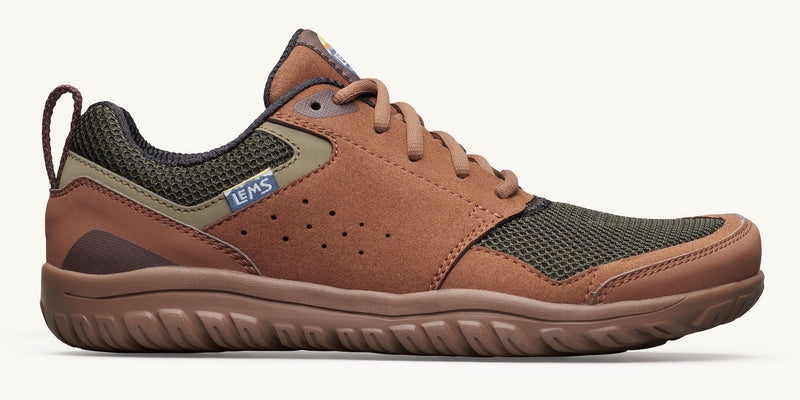
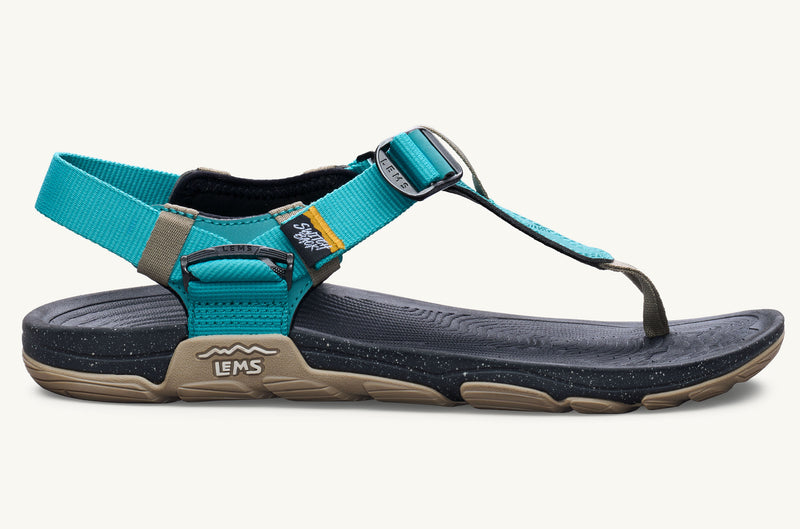
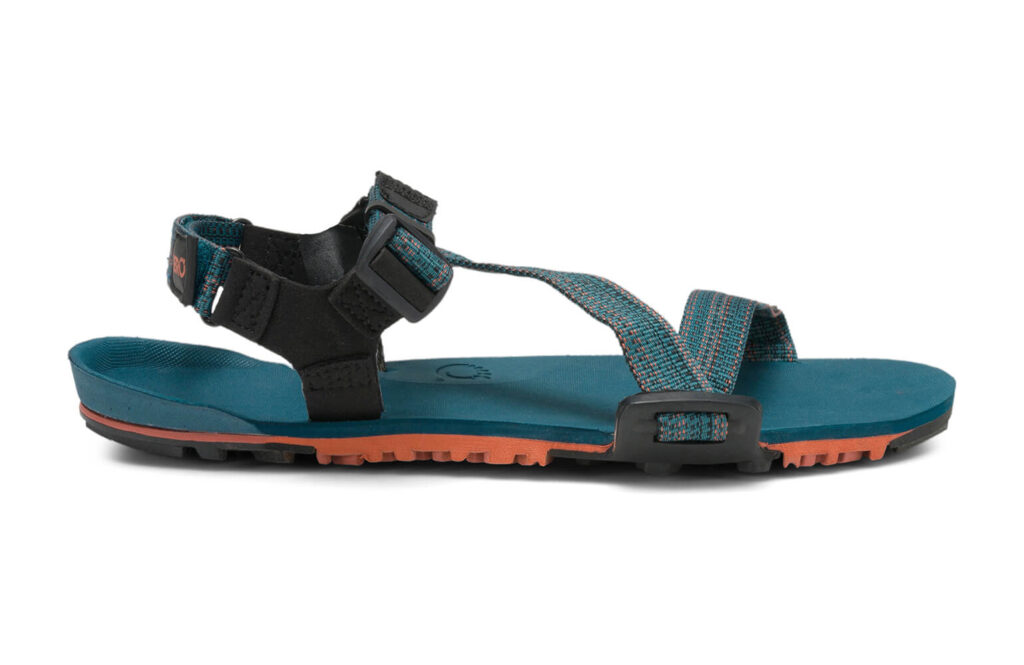
Equipment: LEMs Switchback Sandals or Xero Shoes Z-Trail EV
Strengthening your feet is crucial when transitioning to zero-drop shoes like the Altra Escalante 4. Since traditional shoes provide extra support and cushioning, your foot muscles, tendons, and lower leg stabilizers may be weak. Strengthening them will help prevent injuries like Achilles pain, calf tightness, or plantar fasciitis.
These exercises will improve foot strength, mobility, and endurance, making the transition smoother.
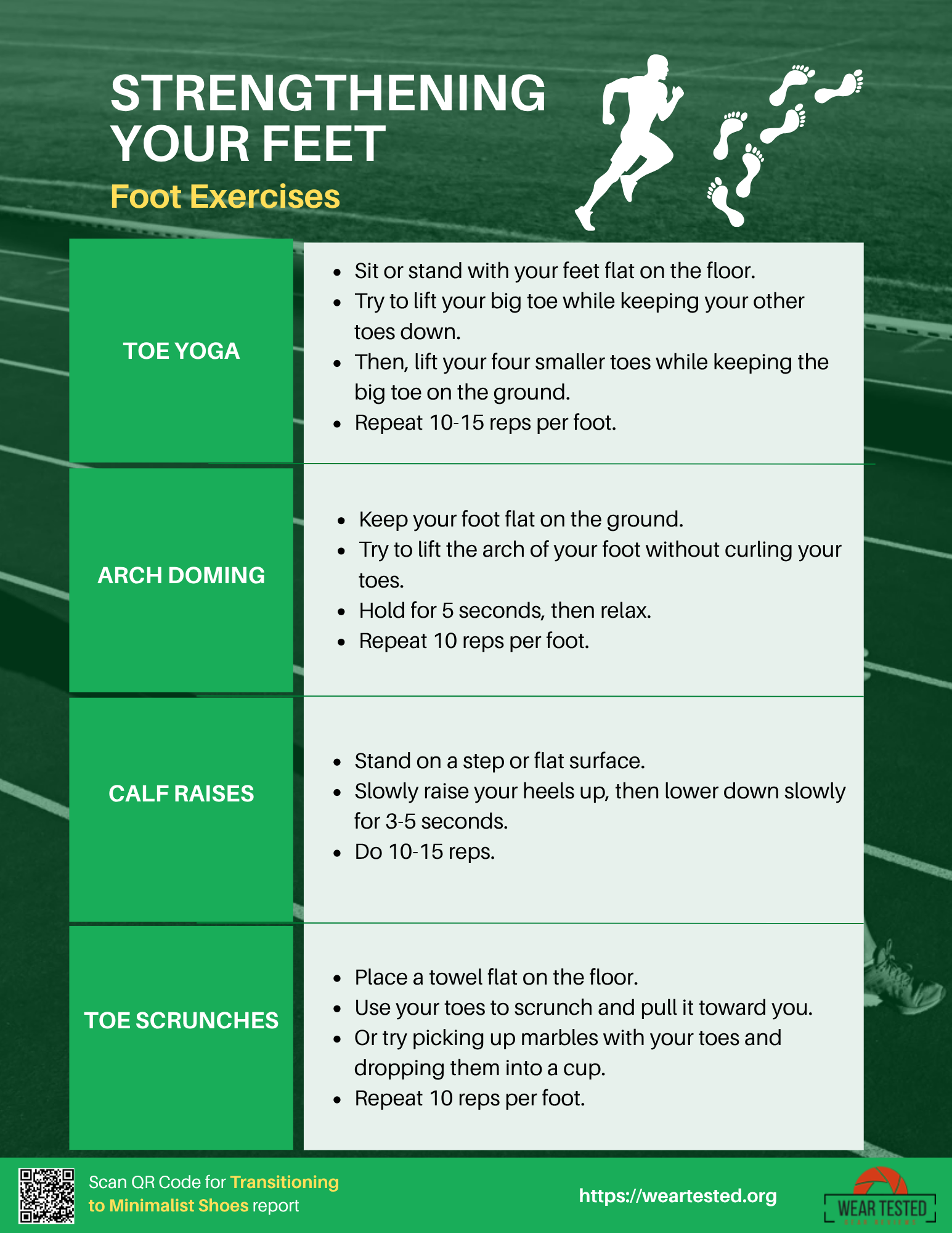
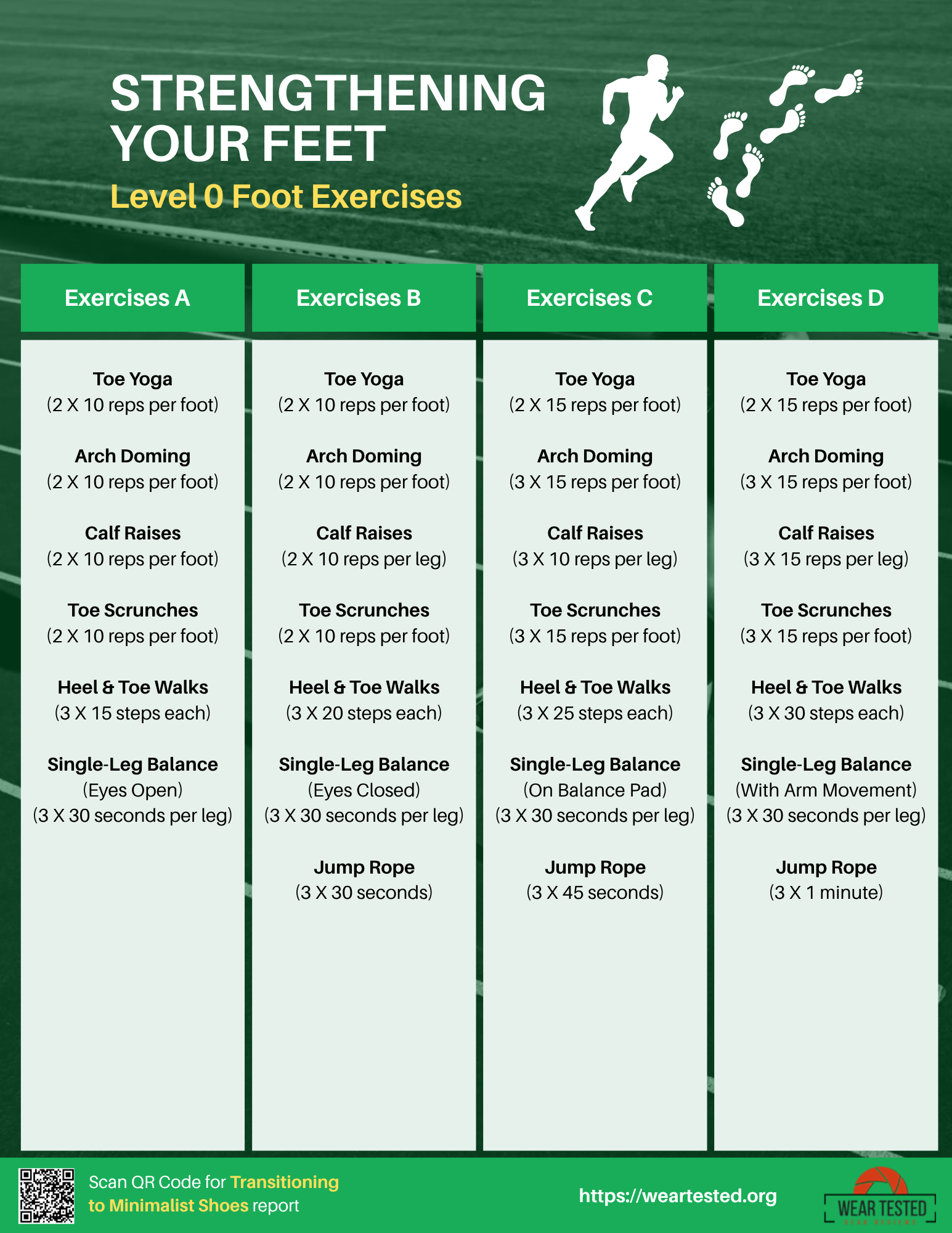
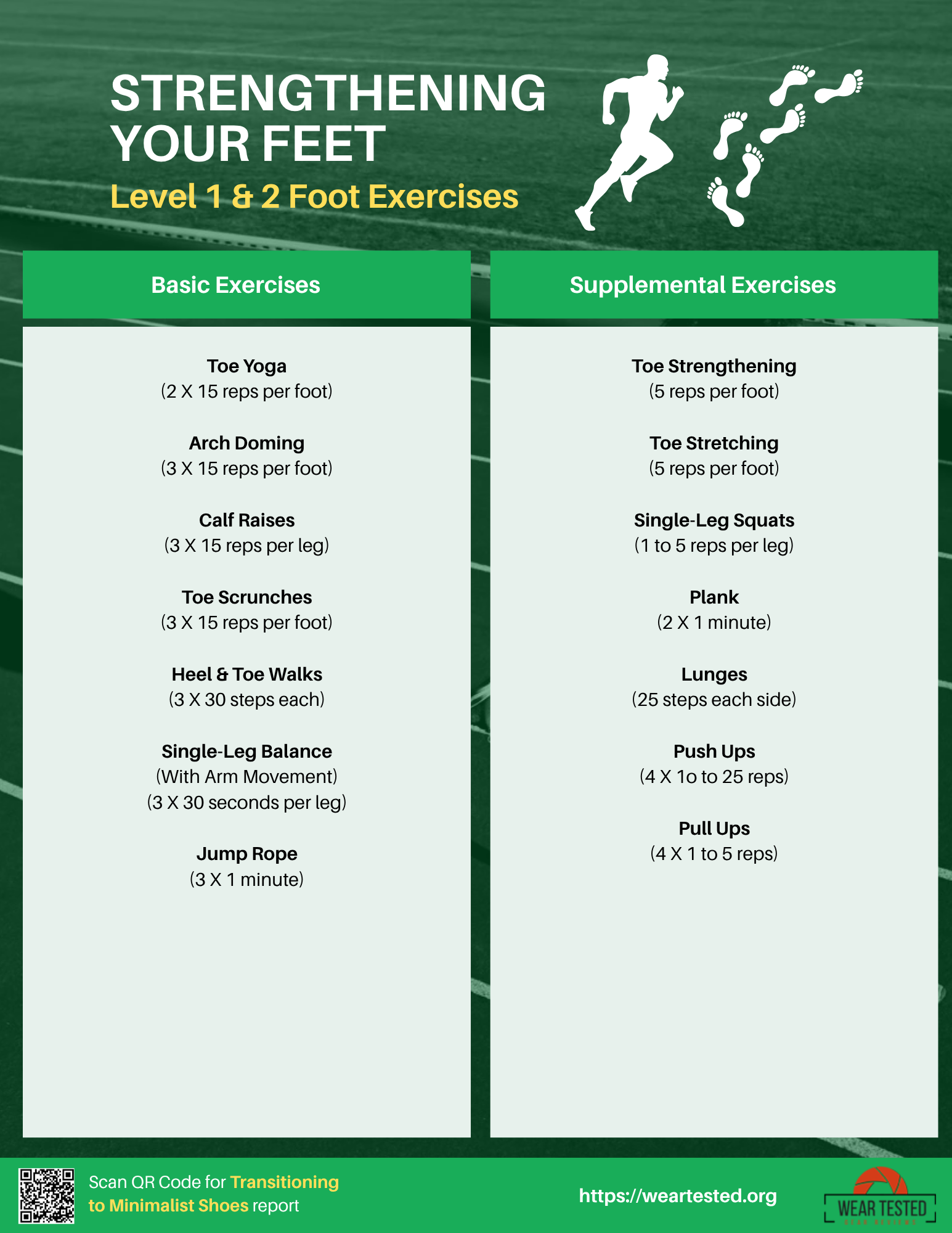
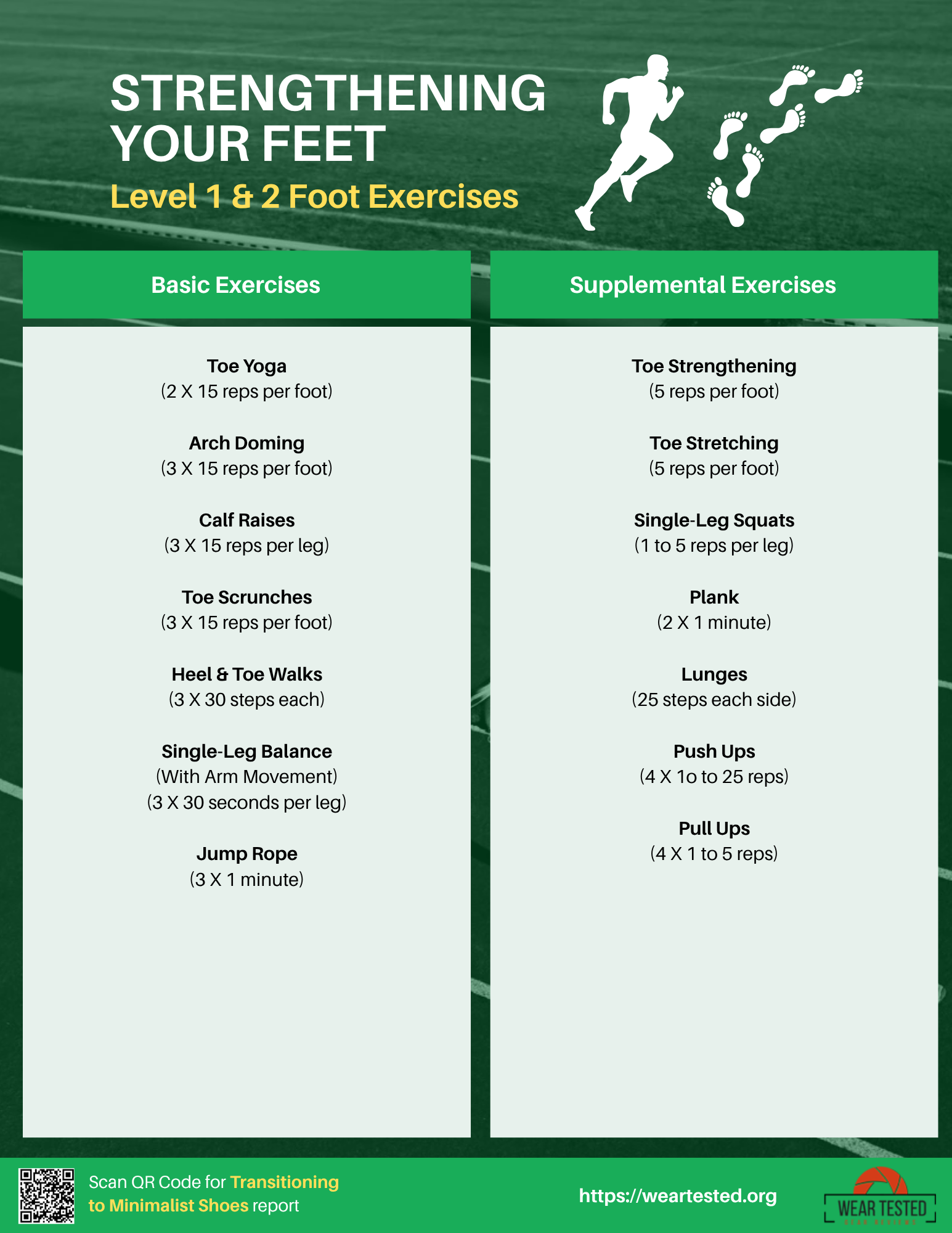
1. Toe Yoga – Toe Lifts & Separations
Why? Strengthens toe muscles and improves mobility.
✅ Helps build better toe control, which is important for balance.
2. Arch Doming
Why? Strengthens the intrinsic foot muscles that support your arch.
✅ Helps reduce foot fatigue when wearing zero-drop shoes.
3. Calf Raises
Why? Strengthens the Achilles tendon and calves, which take on more stress in zero-drop shoes.
Progression: Do it on one leg for more challenge.
✅ Prevents Achilles tendon strain when switching to zero-drop shoes.
4. Toe Scrunches
Why? Builds toe grip strength and activates plantar muscles.
✅ Helps with foot strength and dexterity.
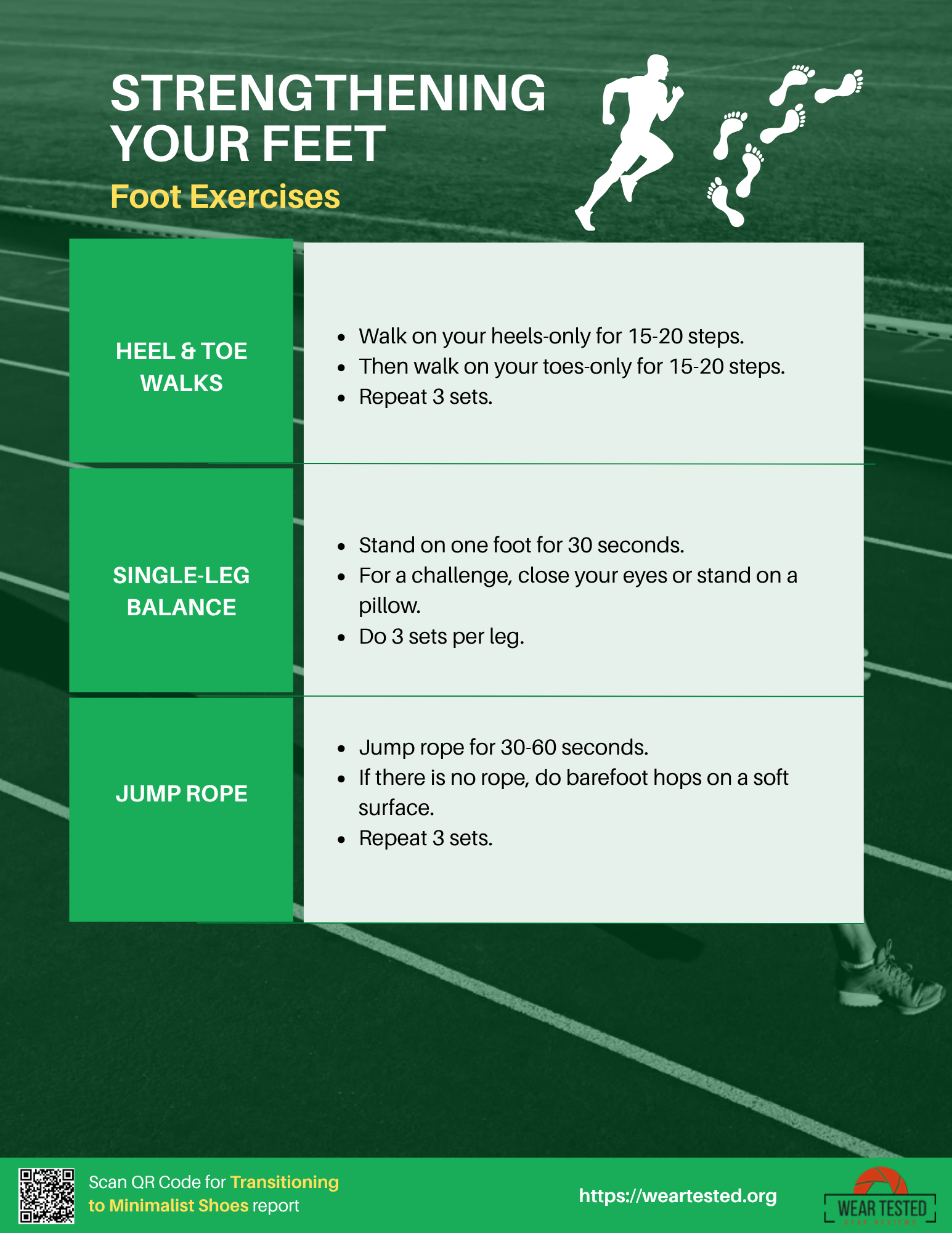
5. Heel & Toe Walks
Why? Strengthens the foot’s stabilizing muscles.
✅ Strengthens foot stability and ankle control.
6. Single-Leg Balance
Why? Improves foot stability and proprioception (awareness of foot positioning).
✅ Strengthens ankle and foot muscles.
7. Jump Rope
Why? Strengthens foot and calf endurance.
✅ Improves impact resistance, making running in zero-drop shoes easier.
Bonus: Walking Barefoot on Different Surfaces
✅ Walk barefoot on grass, sand, or uneven surfaces.
✅ This helps activate foot muscles naturally.
✅ Builds foot strength and adaptability.
How Often Should You Do These Exercises?
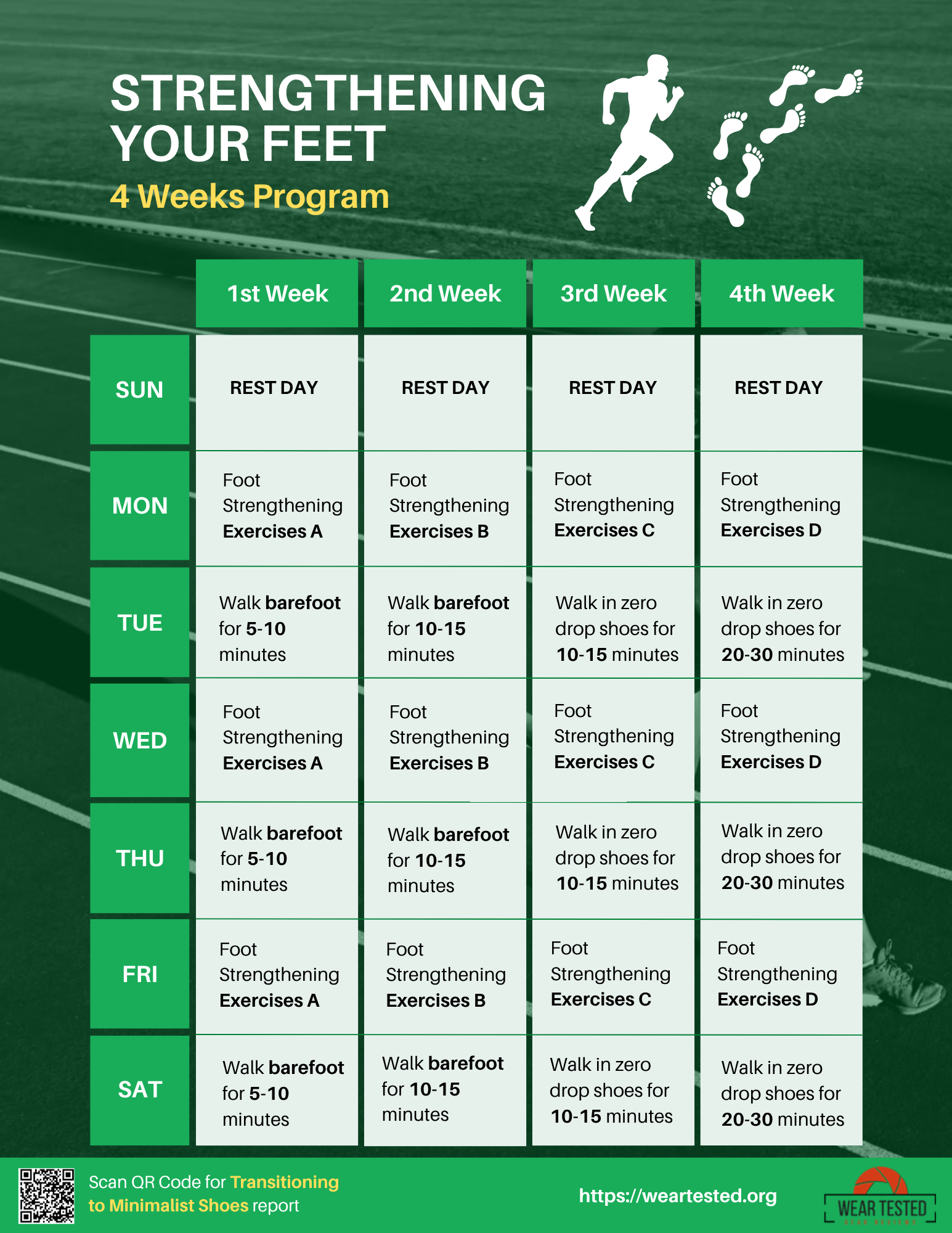
🔹 3-4 times per week for best results. 🔹 Start slowly and increase difficulty as your feet get stronger. 🔹 Combine exercises with gradual use of zero-drop shoes to avoid injury.
Final Tip: Gradual Transition is Key!
Even with strong feet, transitioning too quickly to zero-drop shoes can cause calf tightness or Achilles strain. Slowly increase your time in zero-drop shoes while doing these exercises to avoid injury.
Structured Level 0 Program
Tiered-Transitioning Approach
Altra Running has a transitioning approach that is more forgiving. Start from traditional running shoes (6mm+ drop) to mid-cushioned (4mm drop) transitioning minimalist shoes (Experience Flow or Experience Wild) to low-cushioned (0mm drop) transitioning minimalist shoes (Escalante or Superior). Take your pick.
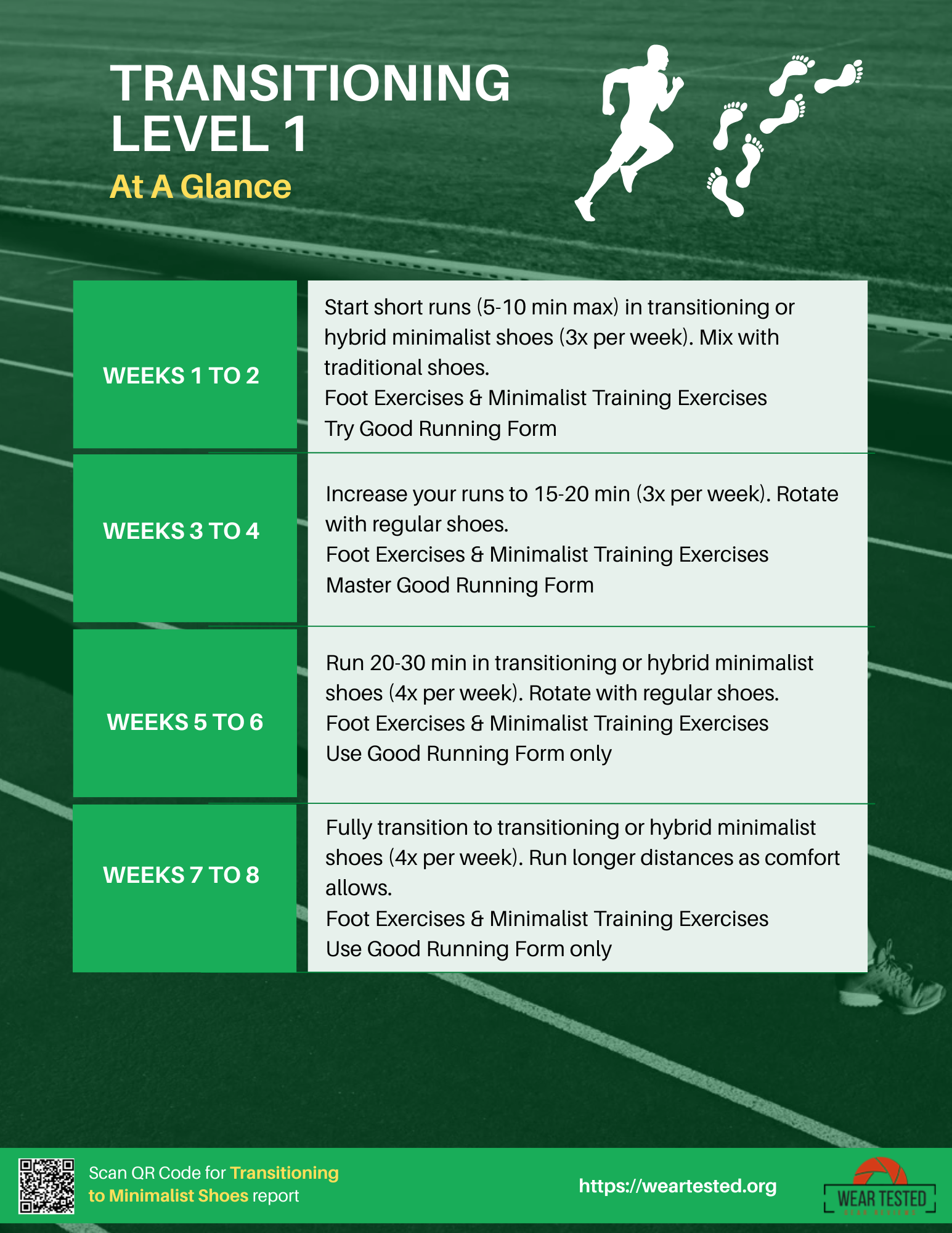
Level 1 Program
Focus: Transitioning to Hybrid Minimalist Shoes from Traditional Shoes
Program Length: 8 weeks.
Equipment: Altra Experience Wild 2 or Altra Experience Flow 2
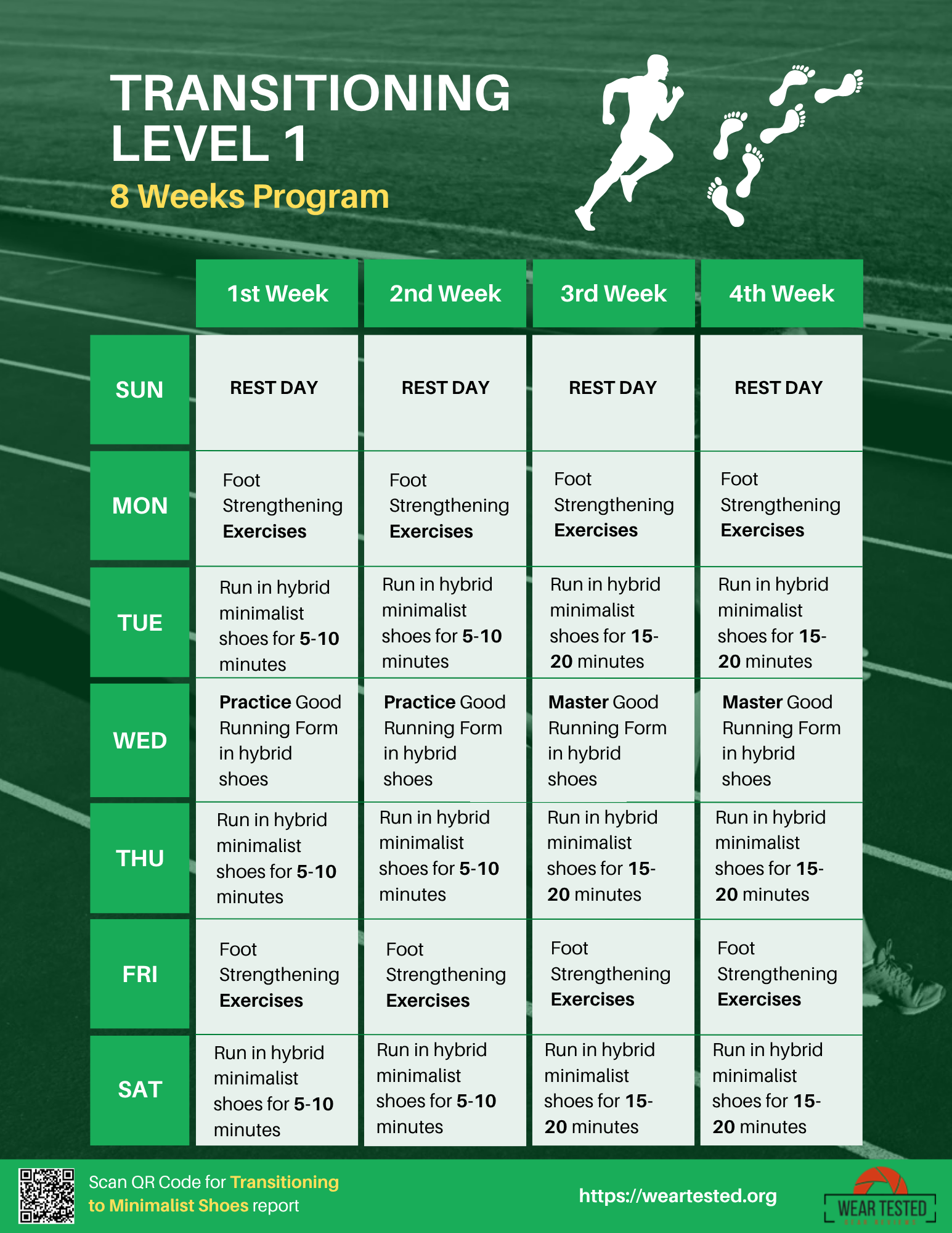
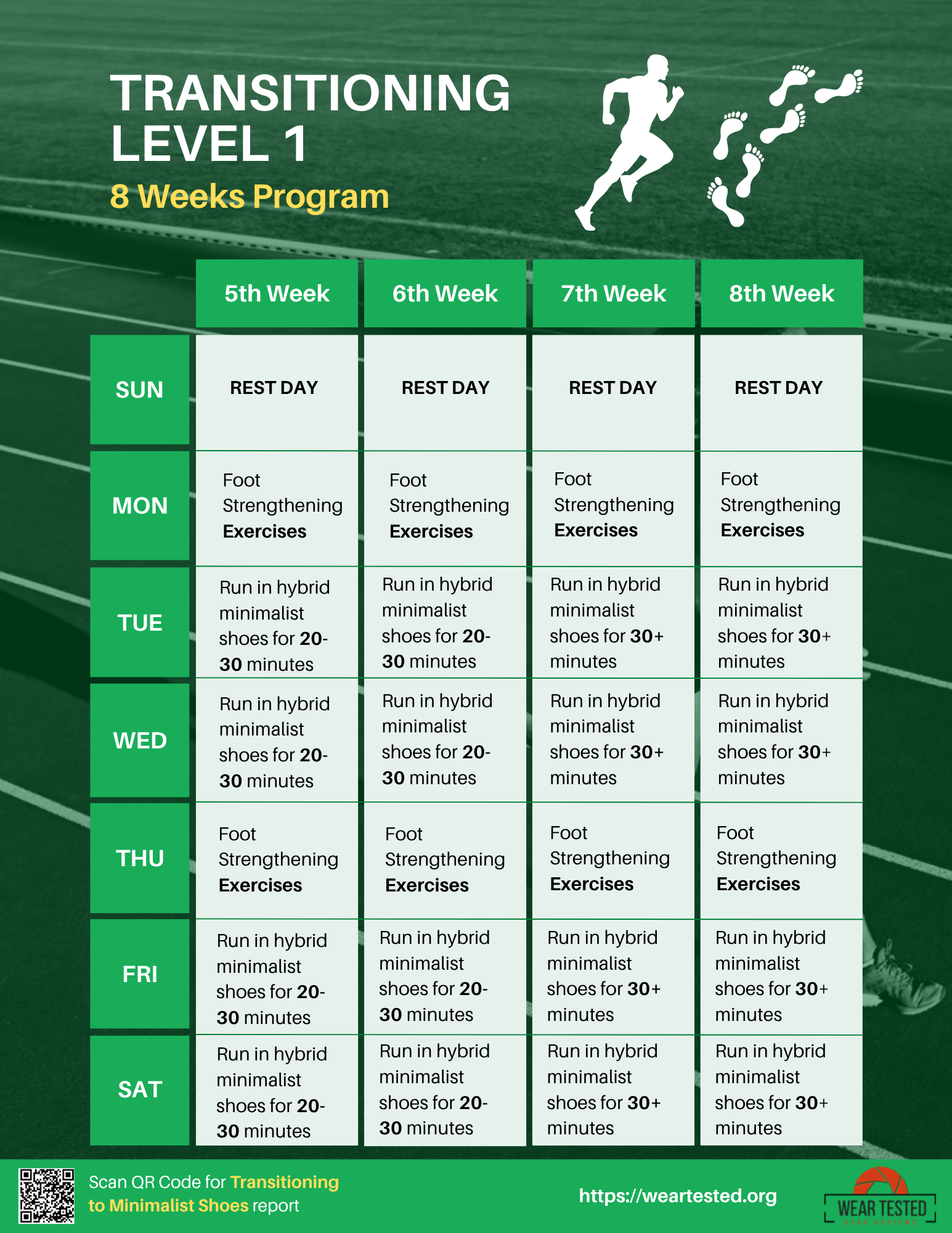
After strengthening your feet for 4 weeks as in the Level 0 Program, you can start the Level1 Program. Transitioning from traditional running shoes to hybrid minimalist shoes (Altra Experience shoes) is a safe way to go slow without hurting yourself. You also learn what Good Running Form (GRF) is. Between GRF and hybrid minimalist shoes, you’re a few weeks away from fully transitioning to running in true minimalist shoes.
WTGR Tip: Start on soft surfaces (grass, dirt, treadmill) before running on asphalt or concrete.
Minimalist Training Exercises
Continue strengthening your feet & calves. Add these extra exercises to stay in shape…
Here are some exercises that will seriously take you to the next level. I go through these sets of exercises at least 5 times a week when I am transitioning. And it gets easier if you don’t skip more than 2 days between them.
These exercises build not just your core and feet but your whole body in general. These exercises are not only for running but benefit various other sports and martial arts. Strengthening these areas means you’re less likely to get injured. I’ve learned most of them from boot camp, running articles, physical fitness books, physical therapists (Rush Medical College), and running coaches.
But what is the core? Your core includes the muscles of your abdomen, lower back, and hips. They’re core because they participate in every single movement you do. A strong core supports your spine and makes your entire body structurally sound.
These exercises also wake up your glutes and core. Strengthening your feet and ankles enables the rest of your knees, hips, and back to function their best and reduce injury.
Warm up with 5 calf raises and 10 jumping jacks before performing these barefoot training routines.
Toe Strengthening
Standing straight, shift your weight to one side and lift your other foot’s heel up slowly such that the toes are still on the floor. Now press your toes on the foot firmly on the ground for 10 seconds. Next, lift that foot up and place the top of your foot on the floor. Press the top of the foot firmly on the ground for 10 seconds. Repeat the same sequence with your other foot.
This will strengthen your feet and especially your toes.
Toe Stretching
Kneel down and keep your heels together, tuck your toes under such that all toes are on the floor. Sit back on your heels and hold for 10 seconds. Repeat 2 more times.
This will stretch and strengthen your toes.
Single Leg Squats
Single leg squats are really hard and are the most challenging leg exercise. It evaluates your mobility, strength, and balance.
Lift one leg and try to keep it straight. Keeping your torso upright, slowly squat down while keeping your arms straight out in front of you. Bend your knee as low as you can without losing balance. Keep the raised leg as straight as possible. Pause and then push yourself back up. Start with 1 to 5 and work your way up to 10.
This will strengthen your feet, quads, hamstrings, and glutes in addition to improving your balance.
Plank
I don’t recommend doing sit ups to strengthen your abdominal muscles – they hurt your back. Instead, doing the plank and push-ups are the alternative and safer ways of strengthening your abdominal muscles.
Making fists with your hands, place your elbows underneath your shoulders. Stretch your legs out behind you as if you are doing a push-up. You should feel your stomach and shoulder muscles working to keep you up.
Don’t let your lower back sink. Keep your back long from shoulders to hips to heels.
Hold for one full minute. Relax. Repeat one more time.
This will strengthen your abdominal and lower back muscles.
Lunges
Take a step forward with your left foot and lower yourself into a lunge position – your left knee should almost touch the ground, and your right thigh should be parallel to the ground. Keep your back straight. Return to the standing position and repeat with the other leg. Do about 25 lunges on each side.
Push-Ups
Get down on all fours and place your hand on the ground so that they are slightly wider and in line with your shoulders.
Lower your body until your chest nearly touches the floor. Then push yourself back to the starting position as quickly as possible.
Start with about 25 pushups. Rest and repeat 3 more sets for a total of 100 pushups.
This will strengthen your abdominal, lower back, and chest muscles.
Pull-Ups
Grab a horizontal fixed bar (or sidebar of a soccer goal) with an overhand grip (palms facing away from you) and hang at arm’s length. Drive your elbows out and down to raise your body until your chin is above the bar. That’s one repetition. Repeat for a set of 5 to 10 repetitions.
This will strengthen your core, upper and middle back muscles.
Dealing with Pain & Aches
Active recovery helps your body recover faster than if you did nothing. It also loosens up your muscles and joints. So, massage and stretch after running or working out (cross training) to help your active recovery to eliminate pain and restore motion.
Tennis Ball
Everyone has a tennis ball at home or has easy access to one. To relieve plantar fasciitis or to loosen your arch, place a tennis ball under your arch and work your way back and forth from the heel to the ball of your foot. Try both inside and outside angles for variation.
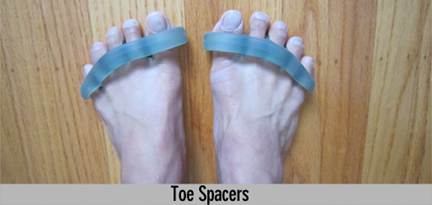
Foot Spacers
Toes are meant to spread and extend thus allowing for optimal balance and stride.
Toe spacers which spread the toes to their natural and correct position improve proprioception, which then allows the brain to better promote balance and optimal muscle function.
I use a Flex-Tastic Toe Relaxer that I bought at my local CVS/Longs. They are also available at your local Target store. Wear them for about 20 to 30 minutes daily.
Specifically, these are some of the benefits:
Massages and relieves sore feet.
Straightens and re-aligns problem toes.
Restores flexibility and circulation.
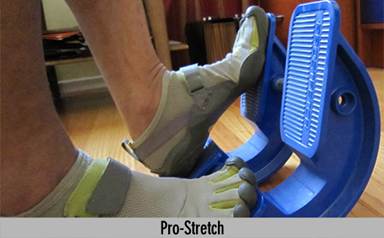
Pro-Stretch
Use a Pro-Stretch device (single or bilateral versions available) for easing plantar fasciitis or to stretch your Achilles tendon – recommended by my sports therapist.
Writing The Alphabets
To strengthen or stretch your tight ankles, try writing the alphabet:
Sit on a chair with your legs off the ground.
Write the entire alphabet in the air with one foot. Use the big toe as your pencil.
Repeat with the opposite foot.
This exercise will use all of the muscles of the ankle.
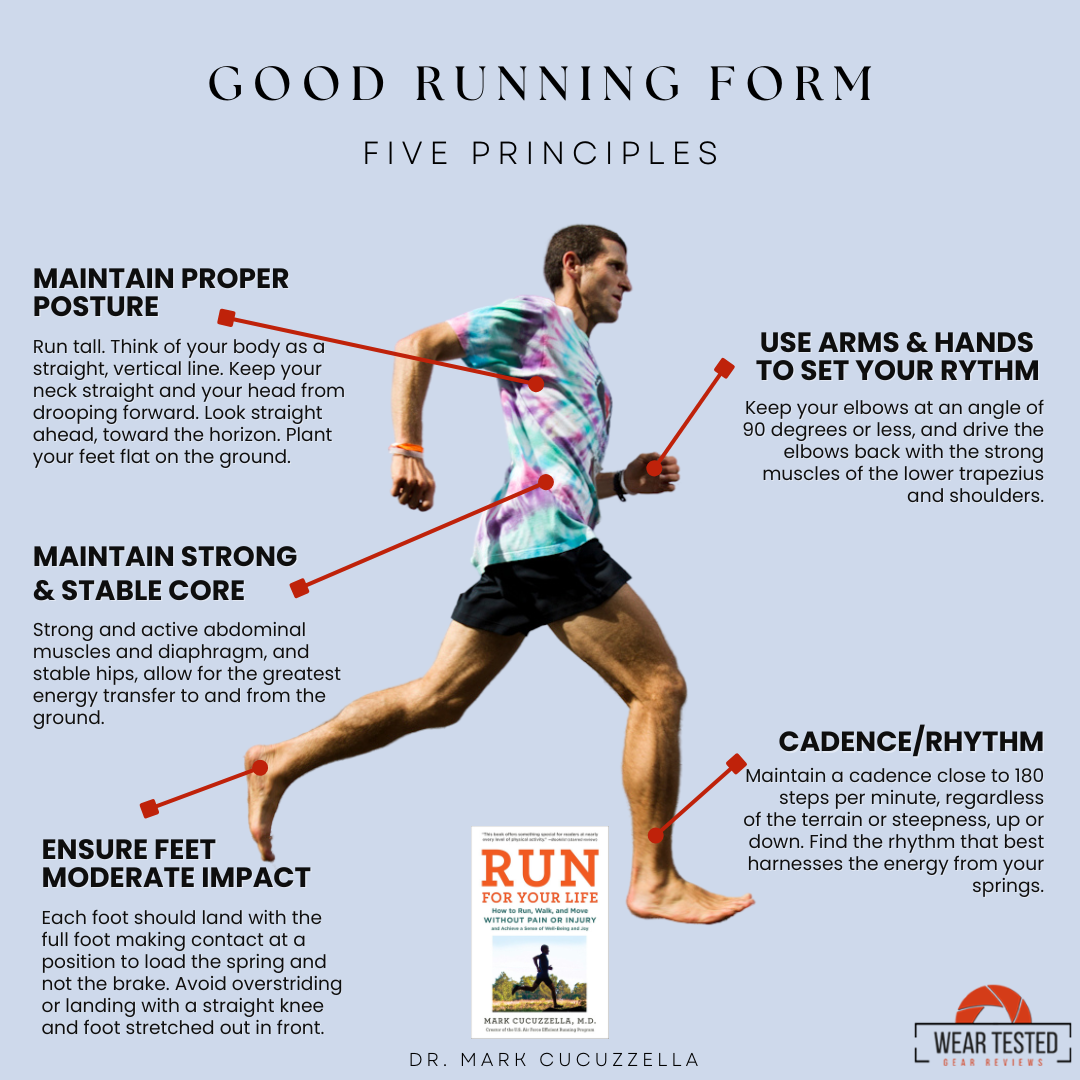
Good Running Form
You MUST adjust your running form. To avoid injury, you change your running style:
✅ Midfoot or forefoot strike → Avoid heavy heel striking, which can cause impact stress.
✅ Lean slightly forward → Helps with propulsion and smooth stride transition.
✅ Relax your calves & ankles → Keep movement light and springy.
✅ Engage your glutes and core for better posture
Structured Level 1 Program
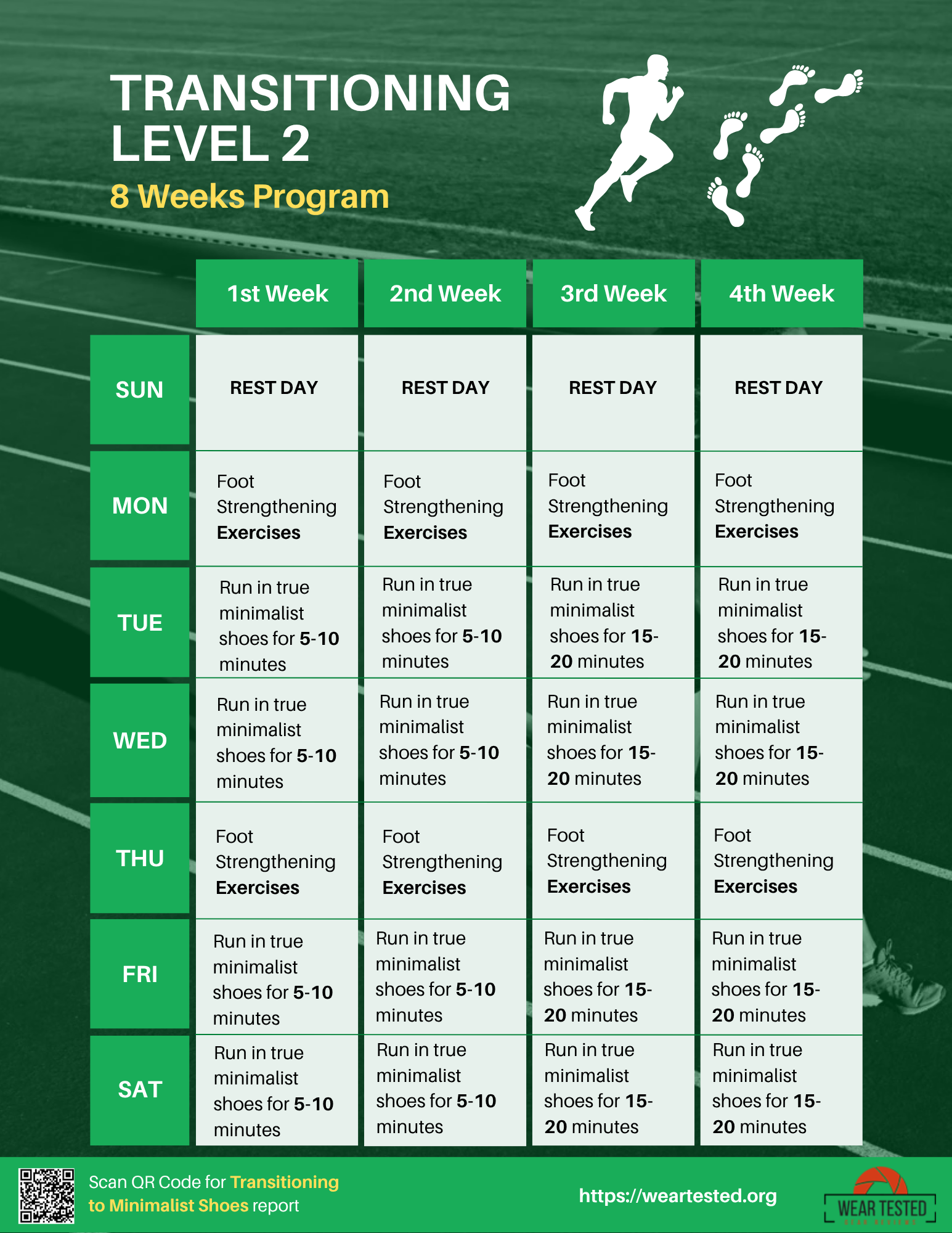
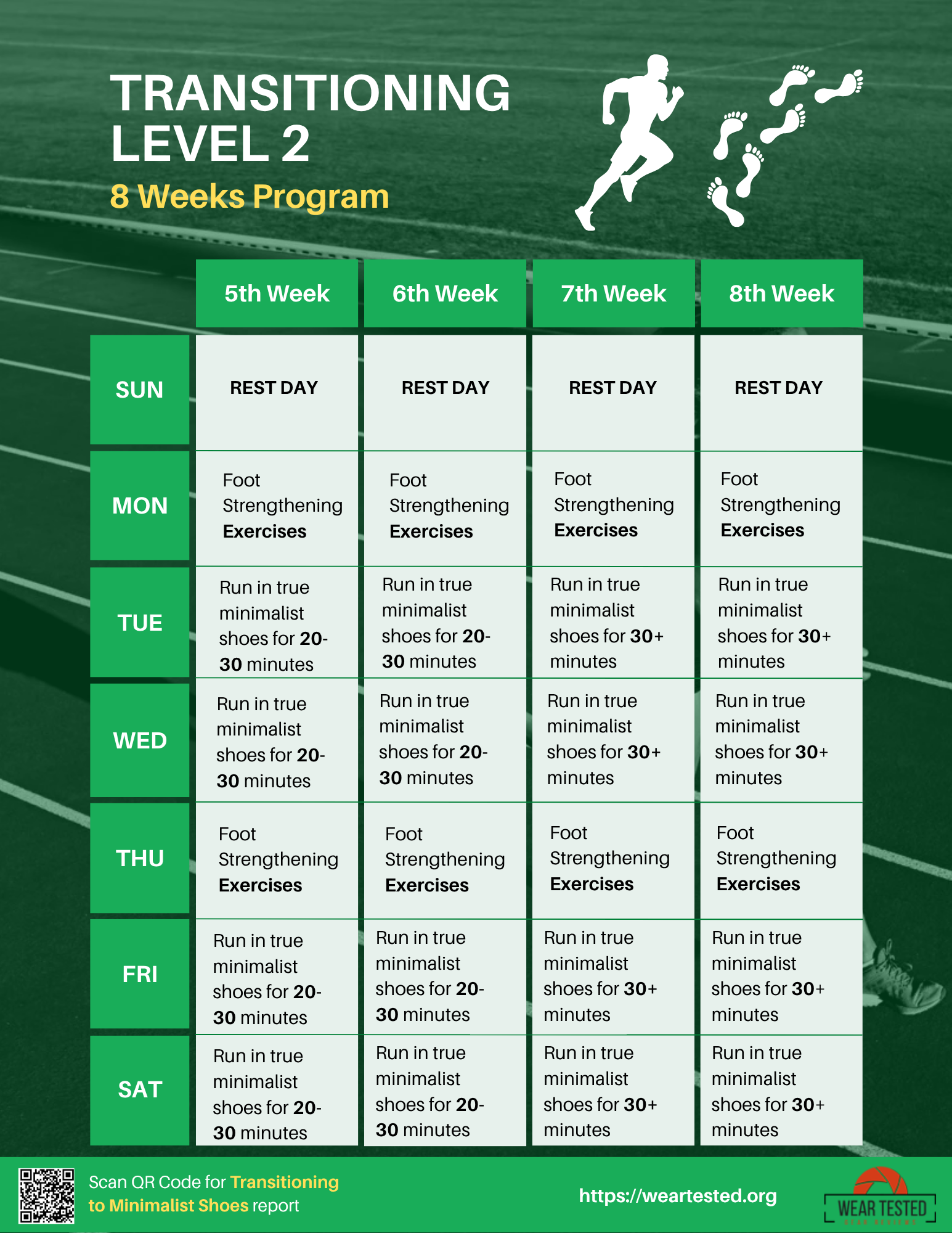
Level 2 Program
Focus: Transitioning to True Minimalist Shoes from Hybrid Minimalist Shoes
Program Length: 8 weeks.
Equipment: Altra Superior 7 or Alta Escalante 4
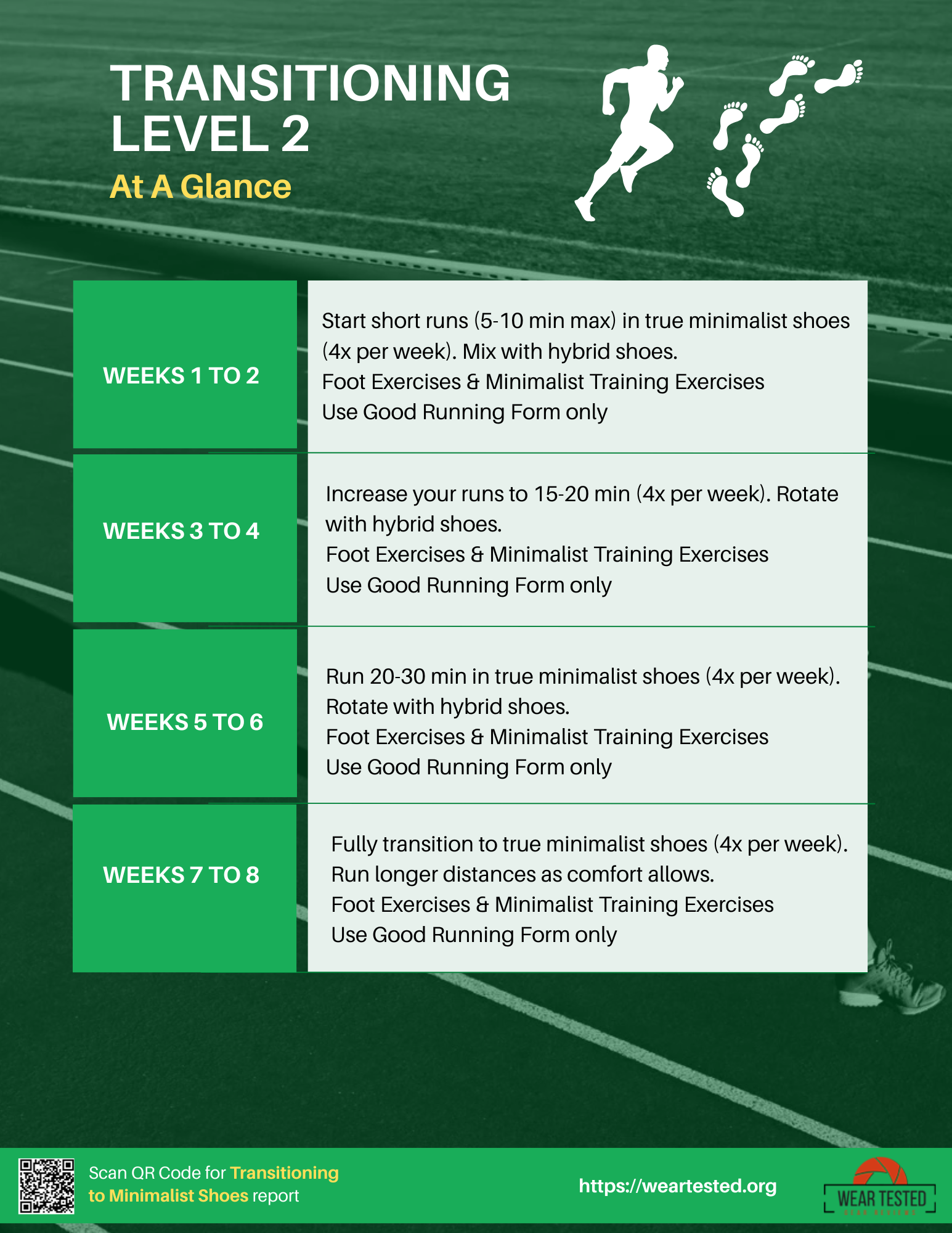
After 8 weeks in the Level 1 Program, you can start the Level 2 Program. Transitioning from hybrid minimalist shoes to true minimalist shoes (Altra Superior or Escalante) is your final phase to safely transition without hurting yourself.
Structured Level 2 Program
Expert Opinions
Physical therapists and podiatrists increasingly recognize the potential for minimalist shoes to improve foot health, but stress the importance of a slow, mindful transition.
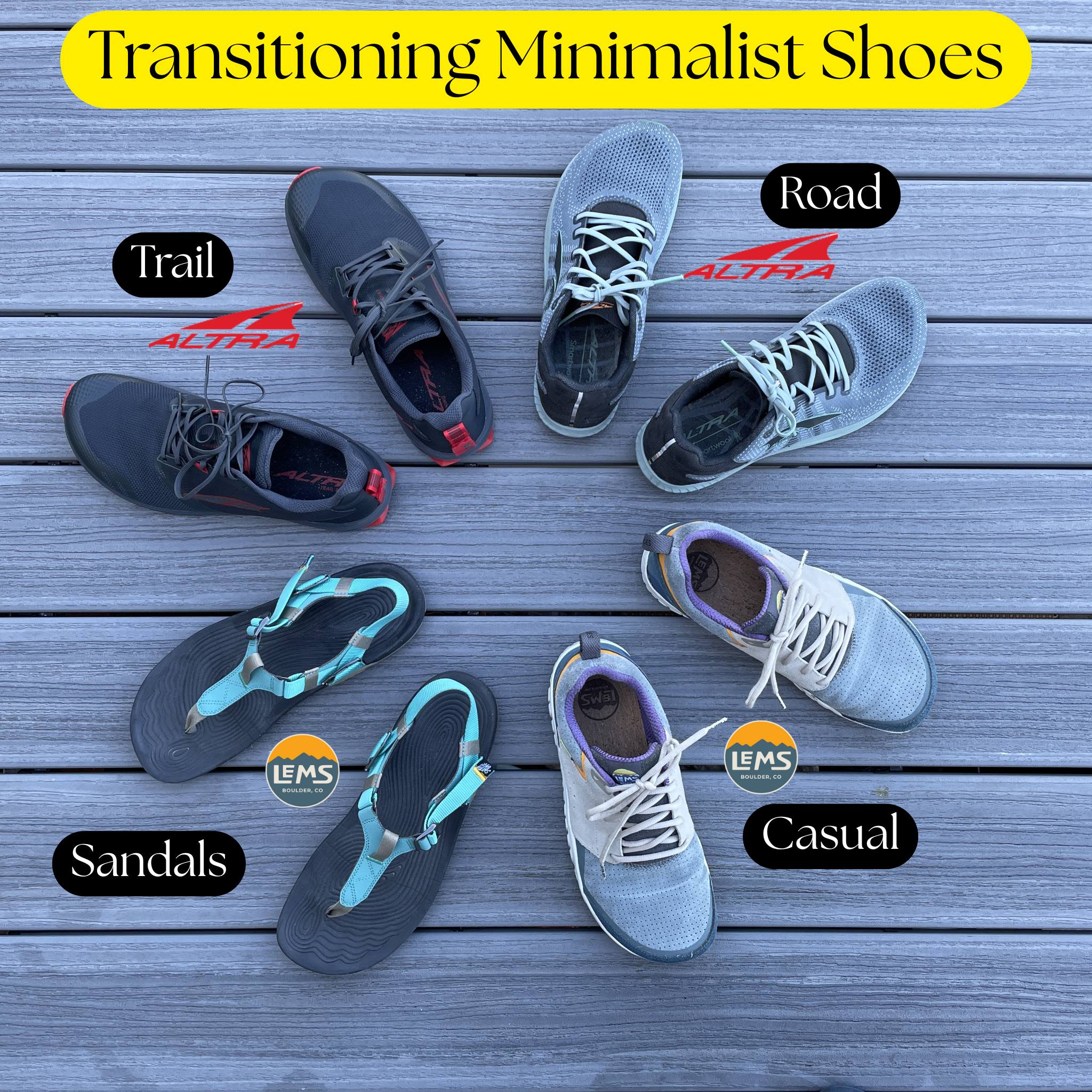
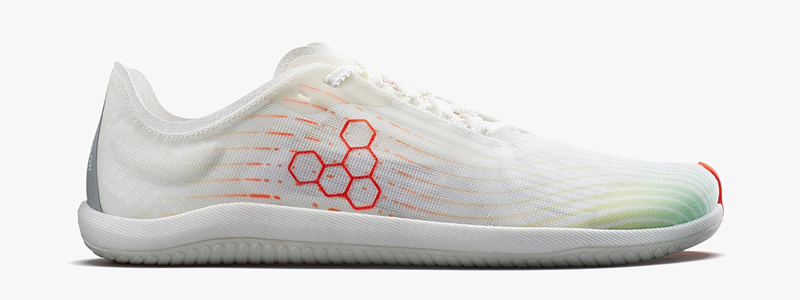
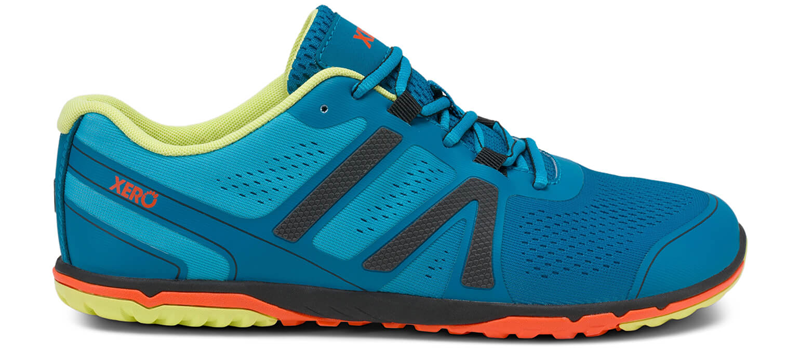
Companies like Altra Running, Vivobarefoot, XeroShoes, and LEMs Shoes are leading the minimalist movement, offering a range of shoes designed to support natural foot function.
WTGR/NRC Personal Experiences
After you have fully transitioned to true minimalist shoes, you have to maintain wearing the least cushioned minimalist shoes (Altra Running, Xero Shoes, LEMs Shoes, VIVOBAREFOOT, and Carets) as much as possible. Wear hybrid minimalist shoes onlyif you have to for certain activities like rucking or recovery or long training days. You want your feet to stay healthy and not depend on cushioning – minimize any chances of muscle atrophy.
It takes less than two weeks for your feet to adjust and if you have plantar fasciitis like I do, you’ll notice immediately. So, I go back and forth DAILY between wearing hybrid minimalist shoes for daily rucking and back to true minimalist shoes for all my other activities – walking, running, cycling, hiking, strength & power training. This way, you also work different muscles on your feet and legs on varied terrains and differing minimalist shoes.
Recent Studies and Statistics
Recent studies (2020–2025) highlight several scientifically validated benefits of minimalist footwear, emphasizing foot strength, biomechanics, and injury prevention.
Increased Foot Muscle Strength and Size
A 2023 systematic review found 9–57% improvements in intrinsic foot muscle strength and 7–11% increases in muscle size after transitioning to minimalist shoes.
An 8-week intervention showed an 8% increase in foot muscle mass through daily walking in minimalist footwear.
Long-term users demonstrate greater longitudinal arch stiffness, linked to improved force distribution during movement.
Enhanced Balance and Proprioception
A 2024 cross-over study revealed 20–30% better postural stability in minimalist shoe users compared to conventional footwear wearers, attributed to heightened plantar sensory feedback.
Walking in minimalist shoes activates 15–25% more gastrocnemius and tibialis anterior muscle activity, enhancing dynamic balance control.
Natural Gait Optimization
Minimalist shoe use promotes midfoot/forefoot striking patterns, reducing ground contact time by 12–18% compared to heel-strike dominance in traditional shoes.
Runners transitioning to minimalist footwear show 5–8% improvements in running economy due to reduced braking forces and optimized stride mechanics.
Injury Risk Reduction (With Proper Transition)
A 2025 longitudinal study found 23% lower incidence of plantar fasciitis in gradual minimalist shoe adopters versus conventional shoe users.
Controlled transitions (6+ months) correlate with 40% fewer repetitive stress injuries in knees and hips due to improved load distribution.
Improved Mobility in At-Risk Populations
Older adults using minimalist shoes demonstrated 18% better performance in balance tests, reducing fall risk.
Patients with early-stage bunions showed 11–15° improvements in hallux alignment after 6 months of minimalist shoe use.
National Library of Medicine, ‘Does an acute transition to different footwear conditions affect walking patterns in people with different experiences of minimalist footwear?’
National Library of Medicine, ‘Enhanced Foot Proprioception Through 3-Minute Walking Bouts with Ultra-Minimalist Shoes on Surfaces That Mimic Highly Rugged Natural Terrains’
International Journal of Experimental, Clinical, Behavioral and Technological Gerontology, ‘Long-Term Effects and Impressions of Minimal Footwear in Older Adults’
National Library of Medicine, ‘Minimalist Footwear in the Treatment and Rehabilitation of Lower Limb Impairments Across the Life Course: A Scoping Review’
National Library of Medicine, ‘Effects of technological running shoes versus barefoot running on the intrinsic foot muscles, ankle mobility, and dynamic control: novel cross-sectional research’
Nature Scientific Reports, ‘The influence of foot muscles exercises and minimalist shoes on lactate threshold velocity in long-distance amateur runners: a randomized controlled trial’